10,000 Vrms isolation — where this part lives on the safety margin curve
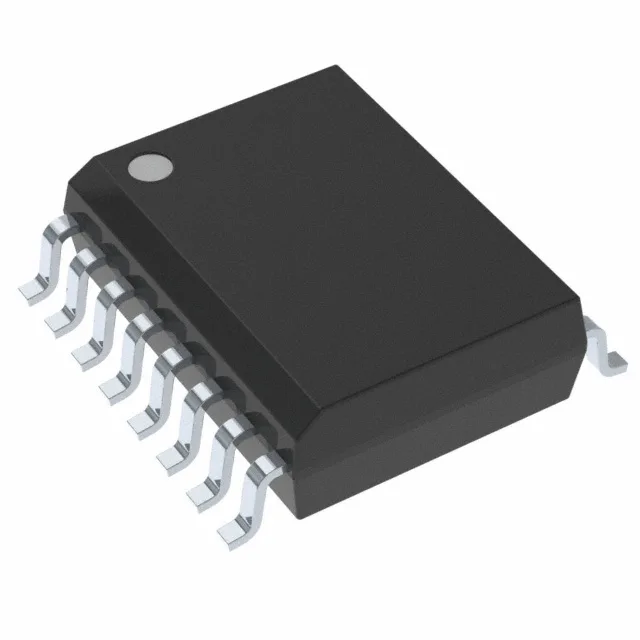
The ADUM342E1BRWZ-RL is a quad-channel digital isolator from Analog Devices using magnetic coupling to deliver 10,000 Vrms of galvanic isolation across a 16-SOIC package. That 10 kVrms rating places it well above the 3 kVrms or 5 kVrms tiers common in industrial isolators, giving the design a substantial safety margin for reinforced insulation in 400 V battery packs, traction inverters, or grid-tied power stages where a single fault must not create a shock hazard. The four channels are unidirectional, arranged 2/2 (two inputs on side 1, two on side 2), which suits split-bus architectures like a CAN transceiver on the isolated side talking to an MCU on the controller side.
150 Mbps and 100 kV/µs CMTI — the dynamic specs that matter in switching environments
Data rate of 150 Mbps covers SPI clock rates up to 100 MHz with margin and handles CAN FD arbitration phases without stretching bit timing. The 100 kV/µs common-mode transient immunity is the spec that keeps data valid during fast voltage slew events — think SiC MOSFET switching edges or a motor-drive PWM transition. Propagation delay is a max of 10 ns in both directions, and pulse-width distortion stays under 3 ns, which means the isolator introduces negligible jitter or skew into timing-critical signals like a CAN bus bit sample point.
The supply range spans 2.25 V to 5.5 V on both sides, so the same isolator can bridge a 3.3 V microcontroller domain to a 5 V CAN transceiver or a 2.5 V sensor interface without external level translators. Rise and fall times are a typical 2.5 ns, keeping signal integrity clean across the isolation barrier at the rated data rates.
The magnetic coupling technology also avoids the LED degradation and current-transfer-ratio drift that optocouplers exhibit at high temperature, so the isolation performance holds across the full range.