What the 2500 Vrms and 1 Mbps ratings mean for the isolation barrier
The ADUM3402ARWZ-RL is a quad-channel, unidirectional digital isolator from Analog Devices' iCoupler series, built around magnetic coupling technology. It provides 2500 Vrms of galvanic isolation across the barrier, which is the standard rating for basic isolation in industrial fieldbus interfaces, PLC digital I/O modules, and isolated sensor links where the working voltage stays under 300 Vrms. The 1 Mbps data rate is the ceiling for each channel — adequate for SPI clock lines up to 1 MHz, UART at standard baud rates, or general-purpose GPIO isolation, but not for high-speed protocols like USB or 100 Mbps Ethernet. The 2/2 channel split (two inputs on side 1, two inputs on side 2) gives you two channels in each direction, which suits half-duplex interfaces like RS-485 or CAN where the data and enable signals cross the barrier in opposite directions.
25 kV/µs CMTI — the spec that keeps the data clean in noisy environments
This is the figure that determines whether the isolator holds its output state when a fast high-voltage transient slams across the barrier — exactly what happens in a motor drive when an IGBT switches 600 V in tens of nanoseconds. If the CMTI is too low, the output glitches or toggles, which a downstream controller reads as a spurious pulse. At 25 kV/µs this part is comfortable in industrial inverter drives, servo amplifiers, and switched-mode power supply feedback paths where the dV/dt is aggressive. The propagation delay is a maximum 100 ns in either direction, with a 40 ns pulse-width distortion ceiling — tight enough for most 1 Mbps signalling without skew-induced bit errors.
Temperature range and package — where it physically goes
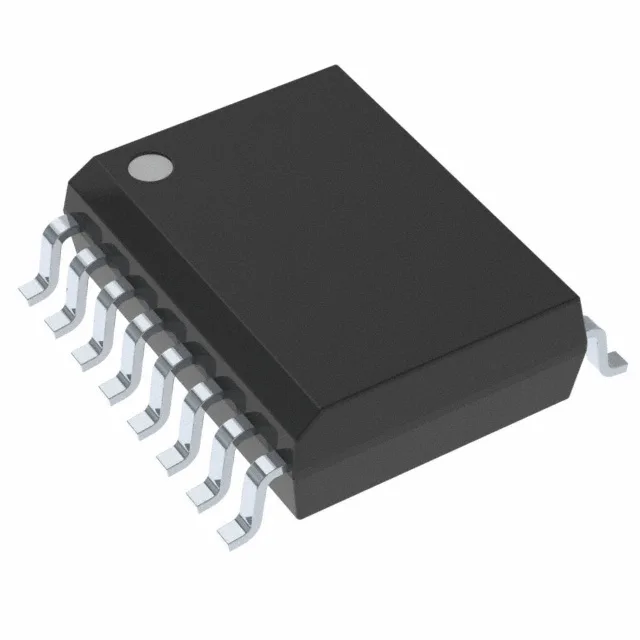
That covers factory-floor cabinets, outdoor telecom shelters with solar heating, and engine-bay-adjacent electronics in off-highway vehicles. It does not reach the full automotive under-hood range (125°C), so if the ambient around the part exceeds 105°C, you need a higher-temperature isolator. The package is a 16-pin wide-body SOIC (7.50 mm body width), which is the standard footprint for 2500 Vrms reinforced isolation in this channel count. The wide-body gives the creepage distance needed to maintain the isolation rating across the PCB — the narrow SOIC-16 would not hold 2500 Vrms reliably.