Three-channel unidirectional isolator with magnetic coupling
It provides 2500Vrms isolation across a 3V to 5.5V supply range, with a 1 Mbps data rate and 100 ns propagation delay. The 25 kV/µs common-mode transient immunity keeps data intact in noisy switching environments like motor drives and industrial power supplies. All three inputs are on side 1, making it a straight 3/0 forward-direction isolator — no reverse channel.
The 1 Mbps data rate covers most UART, I2C, and low-speed SPI isolation needs. If your design runs a 10 MHz SPI bus or a high-speed CAN FD link, this part will bottleneck — step up to an ADuM140x or ADuM120x with 10 Mbps or 150 Mbps. The 100 ns propagation delay (max) and 40 ns pulse-width distortion add about 200 ns of total jitter budget to your timing closure. For a 1 Mbps UART at 8N1, that's well inside the bit-time margin.
25 kV/µs CMTI — why it matters for motor drives and PFC stages
Common-mode transient immunity of 25 kV/µs (minimum) means the isolator's output won't glitch when a fast voltage transient slams across the isolation barrier — exactly what happens during IGBT switching in a motor drive or SiC FET transitions in a power supply. If your system has a switching node with dV/dt above 10 kV/µs, this part keeps the digital link clean. Below that threshold, almost any isolator works; above it, the ADUM3300ARWZ is the right entry point.
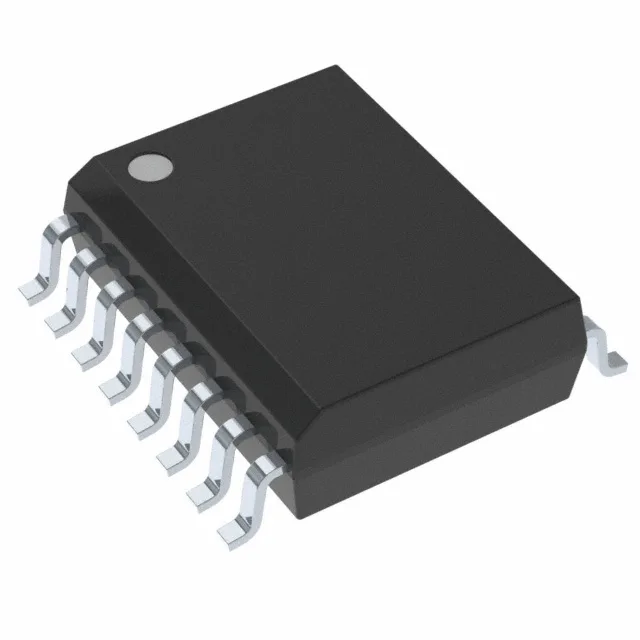
The 16-pin SOIC-7.5 mm wide-body package (0.295" body width) provides 8 mm creepage distance for basic 2500 Vrms reinforced isolation — enough for most industrial safety barriers. Surface-mount only, tube shipping.
It is ROHS3 compliant. The iCoupler series has broad second-source compatibility within the ADuM33xx family, but no direct pin-for-pin alternate from another manufacturer is listed — dual-sourcing would require a parametric match to an ADuM1300 or ADuM1400 variant.