25 Mbps, 2500 Vrms — what these ratings mean for the isolation barrier
The ADUM3200CRZ is a 2-channel, unidirectional digital isolator from ADI's iCoupler® family, built around magnetic coupling technology. This combination suits it for breaking ground loops in industrial fieldbus interfaces, motor-drive feedback paths, and isolated sensor links where the data rate stays under 25 Mbps and the isolation requirement is 2500 Vrms.
Propagation delay and pulse-width distortion — timing budget factors
Maximum propagation delay is 45 ns in both directions, and pulse-width distortion is held to 3 ns max. For a 25 Mbps signal (40 ns period), the 45 ns delay consumes most of the bit period, so this part is best suited for slower serial interfaces like SPI at reduced clock rates or UART, not full-rate 25 Mbps continuous streams where timing margin would be tight. The 2.5 ns typical rise/fall time keeps edge transitions clean for the signal integrity budget.
CMTI and isolation — where the 25 kV/µs matters
The 25 kV/µs minimum common-mode transient immunity means the output stays valid when a fast voltage transient slams across the isolation barrier — exactly what happens in a motor-drive inverter phase leg or a switching power supply half-bridge. The 2500 Vrms isolation rating covers basic insulation for 240 VAC mains-referenced circuits. No isolated power is provided on-chip, so the secondary side needs its own supply rail.
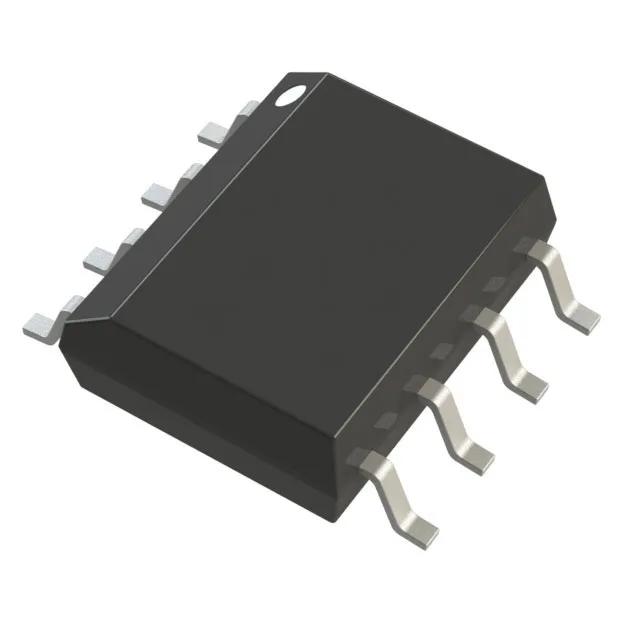
Package and footprint — SOIC-8 layout notes
The unidirectional channel configuration has two inputs on side 1 and zero on side 2 — verify the signal direction matches your application before layout.