Isolation barrier specs that define the BOM fit
The ADUM2400ARWZ is a 4-channel, unidirectional digital isolator from the iCoupler family, using magnetic coupling to transfer logic signals across a reinforced isolation barrier rated at 5000Vrms. It is a general-purpose part intended for applications where galvanic isolation is required between two ground domains — think industrial fieldbus interfaces, motor-drive control signals, isolated SPI/UART links, and medical equipment where patient safety demands high isolation voltage. Data rate is 1Mbps, which sets the ceiling for the serial communication it can pass cleanly. Propagation delay is 100ns max in either direction, with pulse-width distortion held to 40ns max — tight enough for most 1 MHz-class clocked interfaces but not for high-speed CAN or 100Base-T1. Supply voltage spans 2.7V to 5.5V on both sides, so it works in mixed 3.3V-to-5V systems without a separate level shifter. The 4/0 input/output configuration means all four channels run the same direction — side 1 is the input side, side 2 the output side.
CMTI and timing — what matters in a noisy environment
Common-mode transient immunity is specified at 25kV/µs minimum. That is the part's ability to reject fast voltage transients that try to jump across the isolation barrier — a key parameter in motor drives, inverters, and any system with high dV/dt switching edges. If your application has SiC or GaN switching stages, check whether 25kV/µs is enough headroom; the faster siblings in the iCoupler family offer higher CMTI. Rise and fall times are 2.5ns typical, which keeps edge-rate-induced emissions low compared to faster isolators. The 100ns propagation delay is consistent channel-to-channel, so skew within a byte-wide parallel bus is manageable at 1Mbps.
Package, supply, and temperature grade
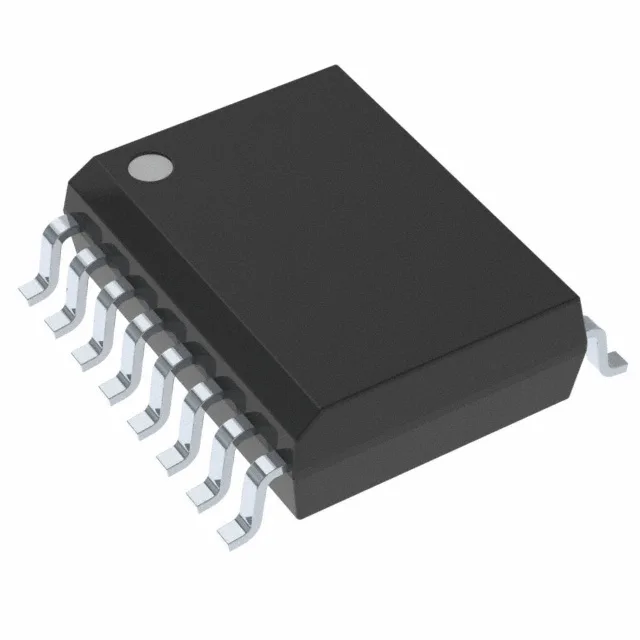
Housed in a 16-pin SOIC wide-body (7.50mm width) — the standard footprint for reinforced isolation in this channel count. No isolated power converter on-chip; each side needs its own supply rail. The 2.7V to 5.5V range on both VDD pins means a single 3.3V rail can power both sides if the application allows, or separate 3.3V and 5V rails for level translation.
ROHS3 compliant.