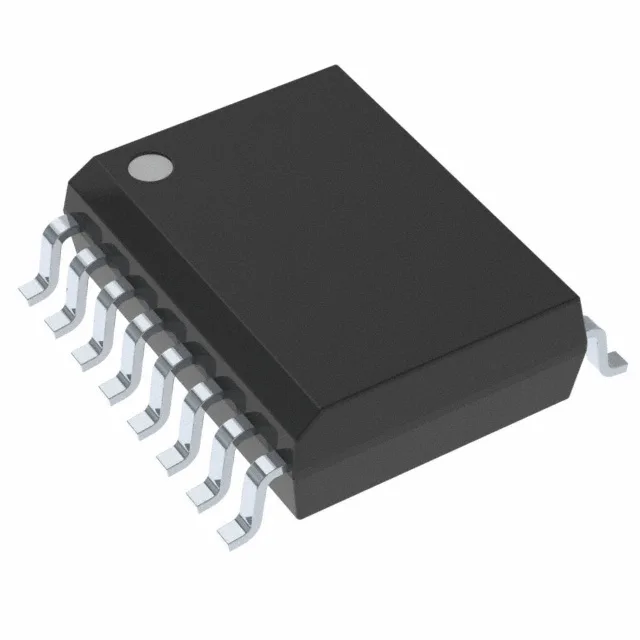
Analog Devices ADUM230E1BRIZ — Digital Isolators

ADUM230E1BRIZ iCoupler Digital Isolator, 3-Ch, 150 Mbps

MPNADUM230E1BRIZ
End of Life

Analog Devices ADUM230E1BRIZ, iCoupler series, 3-channel unidirectional digital isolator, 150 Mbps data rate, 5000 Vrms isolation, 75 kV/µs CMTI, 1.7 V to 5.5 V supply, -40°C to 125°C, 16-SOIC package.

$3.83Ref. price · indicative, final on quote
Packaging16-SOIC (0.295", 7.50mm Width)
StockContact for availability
MOQ1 pcs
  • 100% new & originalTraceable channels only — no refurbs, no pulls, no remarked parts.
  • Date & lot codes on quoteStated per line before you commit; label photos on request.
  • MSL-compliant ESD packingMoisture-sealed bags with indicator cards; reels photo-verified.
  • PayPal buyer protectionPay by T/T, PayPal or Payoneer — card payments covered end to end.

Specifications

ADUM230E1BRIZ Technical Specifications
ParameterValue
TypeGeneral Purpose
SeriesiCoupler®
Channel typeUnidirectional
Mounting typeSurface Mount
Voltage1.7V ~ 5.5V
Voltage - isolation5000Vrms
Isolated powerNo
Operating temperature-40°C ~ 125°C
Pulse width distortion3ns
PackageTube
Data rate150Mbps
TechnologyMagnetic Coupling
Case16-SOIC (0.295\", 7.50mm Width)
Number of channels3
Inputs - side 1/Side 23/0
Rise (Fall time)2.5ns, 2.5ns
Propagation delay tpLH (tpHL)13ns, 13ns
Common mode transient immunity75kV/µs

Product details

Three channels, all forward — where the 3/0 direction matters

The ADUM230E1BRIZ is a 3-channel unidirectional digital isolator from Analog Devices' iCoupler series, built with magnetic coupling technology. All three channels drive from Side 1 to Side 2 (3/0 input/output split), making it a clean fit for forward-only data paths like SPI clock-and-data lines, isolated UART TX, or GPIO expansion where no feedback channel is needed. The 150 Mbps data rate handles most serial protocols without timing pressure — SPI at 50 MHz, UART at several Mbps, or CAN at 1 Mbps all pass with margin. The 5000 Vrms isolation rating is sized for reinforced insulation in motor drives, industrial PSUs, and medical equipment where the safety barrier must hold off mains transients.

5000 Vrms and 75 kV/µs CMTI — the margin for noisy environments

The 5000 Vrms isolation voltage is the headline spec that defines this part's application space. It provides reinforced insulation for equipment connected to mains or high-voltage DC links — motor drives, solar inverters, medical patient-contact interfaces, and industrial sensors with long cable runs. The 75 kV/µs common-mode transient immunity (CMTI) is equally important in those environments: fast-switching IGBTs and SiC MOSFETs can couple several kV/µs across the isolation barrier, and if the isolator cannot reject that dV/dt, data bits get corrupted. The ADUM230E1BRIZ's CMTI rating of 75 kV/µs (minimum) keeps the output state stable through those events.

That simplifies the BOM and saves board area — the isolator itself handles the voltage translation. The 1.7 V minimum also covers the lower end of 1.8 V logic (which can droop to 1.6 V under load) with margin. Propagation delay is 13 ns max (both tpLH and tpHL), and pulse-width distortion stays under 3 ns, so timing skew across channels is tight enough for parallel buses like SPI with multiple chip selects.

Frequently asked questions

Is ADUM230E1BRIZ available via RFQ confirmation?

Availability and current pricing for the ADUM230E1BRIZ are confirmed at quote time. Submit an RFQ through this listing for a real-time price and lead-time check from our independent distribution network.

Can ADUM230E1BRIZ be used with 1.8V logic?

Yes.

What is the data rate of ADUM230E1BRIZ?

The ADUM230E1BRIZ supports a data rate of 150 Mbps, which is fast enough for SPI at 50 MHz, high-speed UART, and CAN without timing margin issues.

What is the difference between ADUM230E1BRIZ and ADUM230D1BRIZ?

The ADUM230E1BRIZ and ADUM230D1BRIZ share the same 3-channel unidirectional architecture, 150 Mbps data rate, 5000 Vrms isolation, and 16-SOIC package. The difference is in the output default state: the '' variant defaults to logic high on the outputs when the input side is unpowered, while the 'D1' variant defaults to logic low. Choose based on whether your system needs a fail-safe high or low state on the isolated side.