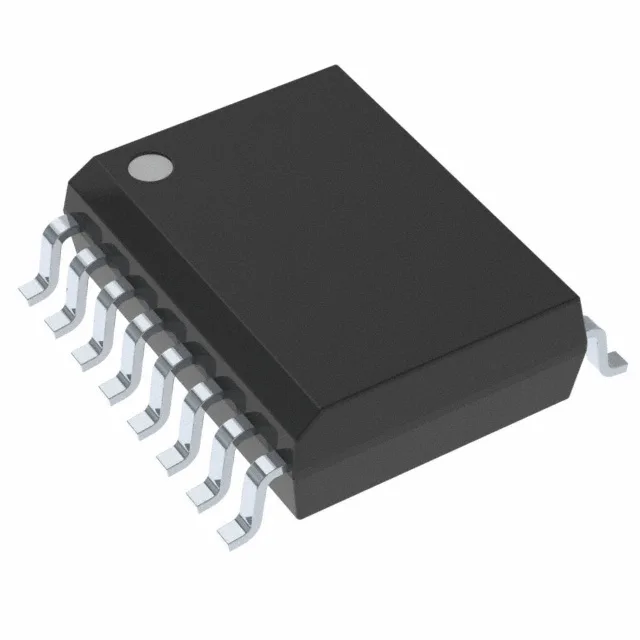
I²C bus isolator — 5000 Vrms, 1 Mbps, bidirectional
It supports bidirectional communication on both data (SDA) and clock (SCL) lines without external direction-control logic, handling standard and fast-mode I²C at up to 1 Mbps.
The 5000 Vrms isolation rating is the headline spec for this part. It means the isolator can withstand a 5 kV potential between the two sides for 1 minute per the test standard, which covers reinforced insulation requirements in medical (IEC 60601) and industrial (IEC 61010) equipment. For a BOM decision, this rating lets you use a single isolator where a lower-rated part would need a second device or external protection to meet safety creepage.
Bidirectional channels — no external direction pin needed
I²C is an open-drain bus where both sides drive the same line low. The ADUM2250ARWZ-RL handles this with a proprietary architecture that senses the bus state and drives the output accordingly, so you don't need a separate direction-control signal or an external buffer. The two channels map to SDA and SCL, with 2 inputs on side 1 and 2 on side 2 — effectively a 2/2 configuration. The pulse width distortion is specified at 145 ns max on one channel and 85 ns on the other, which is tight enough to maintain bus timing margins at 1 Mbps even with the isolation delay.
Common-mode transient immunity — 25 kV/µs minimum
The minimum common-mode transient immunity (CMTI) of 25 kV/µs means the isolator won't glitch when a fast voltage transient slams across the isolation barrier — something that happens in motor drives with PWM switching, or in systems where the two sides power up at different rates. A lower CMTI part would risk data corruption or latch-up in those environments. This spec is a key differentiator for industrial and automotive applications where the ground potential can shift rapidly.
ROHS3 compliant per the listing. If you are stocking for a long-life product, keep an eye on ADI's PCN notifications, but there is no near-term supply risk.