Rated for 150 Mbps, this isolator handles high-speed serial interfaces like SPI at full clock rates without adding a cycle of latency. The 13 ns max propagation delay (tpLH / tpHL) and 4.5 ns max pulse-width distortion keep the digital waveform edges clean enough that you can run the isolation barrier inside a timing-critical feedback loop — think isolated gate-driver feedback or high-speed ADC data capture — without needing to deskew the path. Rise and fall times are a symmetrical 2.5 ns typical, so the output slew matches the input edge rate closely, reducing radiated emissions from the isolation channel.
75 kV/µs CMTI — the spec that matters in motor drives and inverters
Common-mode transient immunity of 75 kV/µs (minimum) is the parameter that determines whether the isolator holds its output state when a high dV/dt pulse slams across the isolation barrier. In a motor-drive or solar-inverter application where the switching node transitions at tens of kV/µs, a lower CMTI part can glitch or latch the output. This part's 75 kV/µs rating gives enough margin for 1200 V SiC and IGBT stages switching at 20–50 kV/µs, so the data sheet number translates directly to reliable operation in the field — not just a lab condition.
Temperature range and package — industrial and automotive deployment
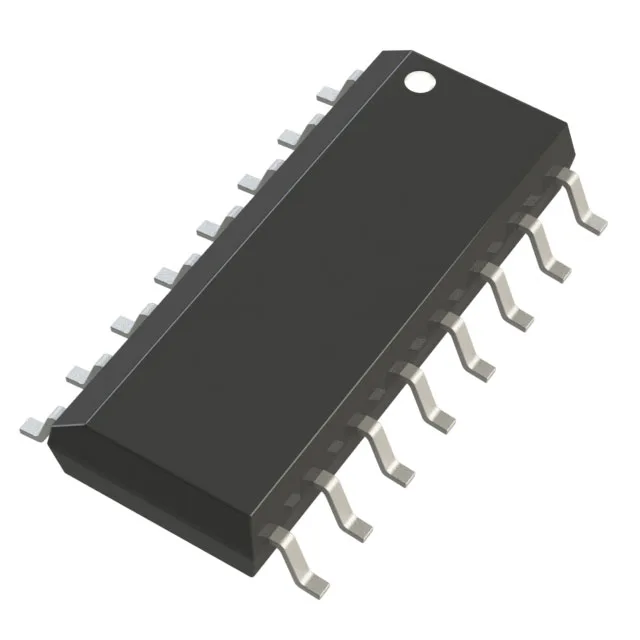
The 16-SOIC (3.90 mm width) narrow-body package fits a standard SOIC-16 footprint, so a board layout designed for a legacy optocoupler-based isolator can often reuse the same land pattern with minor routing changes. The part is ROHS3 compliant.