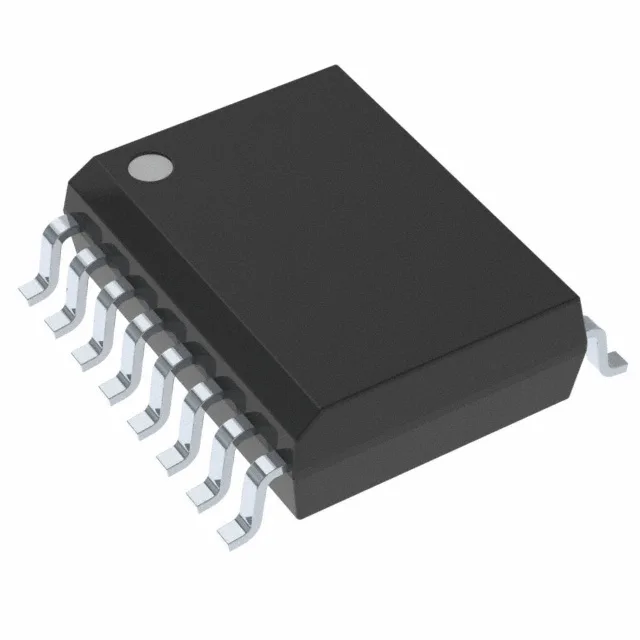
Automotive-grade 4-channel isolator with 150 Mbps throughput
The automotive grade (AEC-Q100 qualified) extends the operating temperature range to -40°C to 125°C, which covers under-hood and chassis-domain environments where commercial-grade parts would derate or fail.
The 3750 Vrms isolation rating is the 1-minute withstand voltage per UL 1577. For a 48 V or 400 V bus system, that gives a solid margin for reinforced insulation in a single device. At 75 kV/µs minimum, the ADUM140E1WBRWZ handles the fast edges from modern wide-bandgap stages without extra filtering. Propagation delay is 13 ns max in both directions, with pulse-width distortion held to 3 ns max. That keeps the data eye open for 150 Mbps NRZ signaling — the 2.5 ns rise/fall times are fast enough that the signal-integrity budget goes to the PCB trace, not the isolator.
4/0 input configuration — all channels on one side
The channel direction is fixed: all four inputs on Side 1, all outputs on Side 2. That is a deliberate choice for applications like SPI isolation (SCLK, MOSI, MISO, CS) where data flows from the controller to the peripheral on three lines and back on one — but here you get only forward-direction channels. If your design needs bidirectional or mixed-direction isolation, the ADUM142D0BRWZ (2/2 split) is the same package and isolation rating with two channels in each direction.
It is ROHS3 compliant.