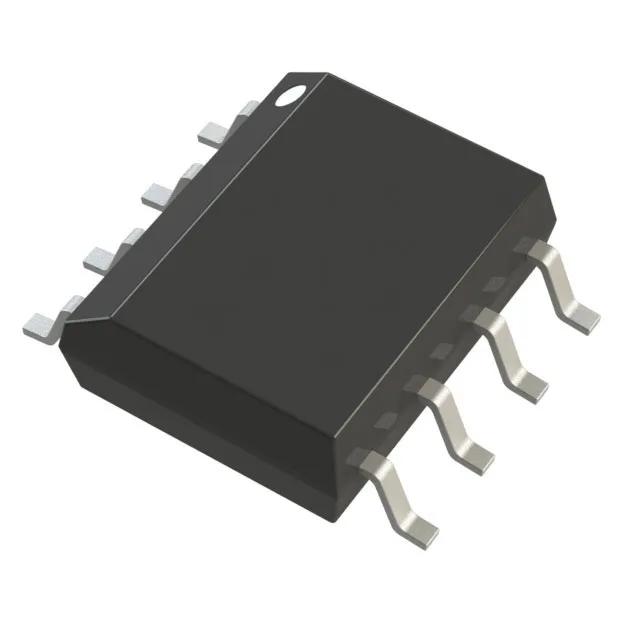
The ADUM1285CRZ-RL7 is a two-channel, unidirectional digital isolator from Analog Devices' iCoupler series, built around magnetic coupling rather than the older optocoupler approach. It delivers 3000Vrms of galvanic isolation across a 3V to 5.5V supply range, with a 100Mbps data rate that comfortably handles SPI clock lines, UART signals, or general-purpose logic-level isolation in industrial fieldbus, motor-drive feedback, and medical patient-interface circuits.
Propagation delay and timing margin
With a 24ns max propagation delay (tpLH / tpHL) and 2ns pulse-width distortion, the ADUM1285CRZ-RL7 adds a predictable, symmetric delay to the signal path. For a 100Mbps NRZ signal (10ns bit period), the 24ns delay is about 2.4 bit-times — acceptable for most isolation barriers where the downstream logic can tolerate a few clock cycles of latency. The 2.5ns typical rise/fall time keeps the edge rate fast enough that the receiving side sees clean transitions, reducing the chance of metastability in a downstream flip-flop.
Common-mode transient immunity — the motor-drive spec
A minimum 25kV/µs CMTI rating means this part holds its output state when a fast voltage transient slams across the isolation barrier — the kind of event you get from an IGBT switching 600V in a few nanoseconds. If your design has a motor drive, an inverter, or a switched-mode power supply sharing a ground with the isolated side, this is the parameter that keeps the data from glitching. The iCoupler magnetic-coupling architecture inherently handles these edges better than an optocoupler, which tends to couple the transient through the LED-to-phototransistor capacitance.
Channel count and direction — two out, none back
Both channels drive from side 1 to side 2 (2/0 input count). That means you get two forward-direction isolated paths, no reverse channel. For a typical SPI isolation job you'd use one channel for the clock and one for the MOSI data, and then need a separate isolator (or a bidirectional variant) for the MISO return. Designers pairing this with a part like the ADUM1201 (which has one forward and one reverse channel) can cover a full SPI bus in two packages.
The 125°C upper limit matches the junction temperature of many motor-drive control boards sitting near the heatsink — no derating worry at the typical 85°C ambient.
ADI lists the ADUM1285CRZ-RL7 as an active product with ROHS3 compliance.