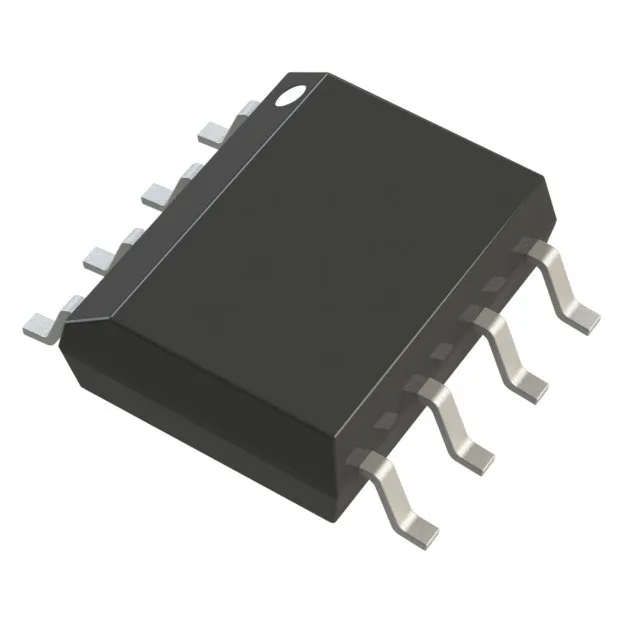
ADUM1285BRZ-RL7

Analog Devices · iCoupler® Series

Analog Devices ADUM1285BRZ-RL7 iCoupler, 2-channel unidirectional digital isolator, 25Mbps data rate, 3000Vrms isolation, 8-SOIC package, -40°C to 125°C.

Analog Devices ADUM1285BRZ-RL7
Download datasheet (PDF)
[IN STOCK] In Stock: 1 pcs
$5.06/ pc

Volume pricing

Buy Now

MOQ 1 · Tape & Reel (TR); Cut Tape (CT) · RoHS · EIA-481 · DAP/DDP · T/T

Technical specifications

ADUM1285BRZ-RL7 specifications
Parameter / AttributeSpecification / Value
TypeGeneral Purpose
SeriesiCoupler®
Channel typeUnidirectional
MountingSurface Mount
Supply voltage3V ~ 5.5V
Voltage - isolation3000Vrms
Isolated powerNo
Operating temperature-40°C ~ 125°C
Pulse width distortion3ns
PackageTape & Reel (TR); Cut Tape (CT)
Data rate25Mbps
TechnologyMagnetic Coupling
Case8-SOIC (0.154\", 3.90mm Width)
Channels2
Inputs - side 1/Side 22/0
Rise (Fall time)2.5ns, 2.5ns
Propagation delay tpLH (tpHL)35ns, 35ns
Common mode transient immunity25kV/µs
100% Footprint Match · Solder-Ready (No PCB Redesign Needed)

Need Stock or a Drop-in Second-Source for ADUM1285BRZ-RL7?

Package: SOIC-8 (narrow body) · Pin-compatible replacements with immediate Shenzhen spot stock

Footprint Match 98%
Supply Chain & Allocation Reality:

The ADuM120x pair is the digital isolator that replaced optocouplers across industrial designs: two channels on a magnetic barrier instead of an LED, 2.5kV of isolation in an eight-pin SOIC, supplies from 2.7V to 5.5V that made 3.3V-to-5V level translation and isolation one component. The naming is a single decision - ADuM1200 carries both channels in one direction, ADuM1201 is the 1/1 bidirectional part - and the generation upgrade is documented pin-for-pin: the N-family maps onto the classic sockets with faster rates and fail-safe output options. The substitution mistake in this family is one character wide and completely fatal to the signal path.

Verified Pin-Compatible Replacements (3 verified alternatives)

ADuM1200 Analog Devices SOIC-8
Pin-to-Pin (Minor Clock/Init Tuning)
Availability & Target Pricing:

The 2/0 Member - Same Socket, Different Direction

Shenzhen Spot Stock (24-48h Dispatch)

Electrical & Core Specs:

The same dual-channel isolator with both channels pointing the same way (2/0 against the 1201s 1/1 direction split): identical timing, identical supplies, opposite topology.

2.7V to 5.5V on either side with independent level translation; 2.5kV RMS isolation.

Compatibility & Drop-In Notes: The substitution rule: same socket, same speed grades (A/B/C at 1/10/25Mbps), same everything except the arrows. A 1200 in a 1201 socket isolates half the bus and inverts the other halfs role - the failure looks like a protocol bug, not a component mistake.
Package & Solder Footprint: Identical SOIC-8 footprint.
Shenzhen Warehouse Stock & MOQ: Stocked as the pair; label the two drawers distinctly.
ADuM121N1 Analog Devices SOIC-8
Pin-to-Pin (Minor Clock/Init Tuning)
Availability & Target Pricing:

The Pin-Compatible Modern Generation

Shenzhen Spot Stock (24-48h Dispatch)

Electrical & Core Specs:

The N-generation replacement documented as pin-compatible with the ADuM1201 (the ADuM120N1 maps to the ADuM1200): up to 150Mbps, lower propagation delay, 100kV/us common-mode transient immunity and selectable fail-safe output (N0 against N1).

1.8V to 5V supplies; 3kV RMS isolation class.

Compatibility & Drop-In Notes: The upgrade direction is calm: pin-compatible into the classic sockets with better performance. The one review: which fail-safe behavior the design assumed during power sequencing - check the N0/N1 suffix against the board behavior before standardizing.
Package & Solder Footprint: Same SOIC-8 land pattern.
Shenzhen Warehouse Stock & MOQ: Active production; the forward buy for the socket.
ADuM1285 Analog Devices SOIC-8
Pin-to-Pin (Minor Clock/Init Tuning)
Availability & Target Pricing:

The Direction-Swapped N Option

Shenzhen Spot Stock (24-48h Dispatch)

Electrical & Core Specs:

The N-generation mapping option for same-direction duty (the N0 variants map onto the 1285/1286) with fail-safe-high output behavior.

Modern low-voltage envelope; same isolation class.

Compatibility & Drop-In Notes: In repair, the pattern to keep: the N family is a small matrix of direction x data-rate x fail-safe - three coordinates, all encoded in the suffix. Any substitution ends by checking the coordinate, not the family name.
Package & Solder Footprint: SOIC-8 shared land pattern.
Shenzhen Warehouse Stock & MOQ: Stocked with the N row; documented ordering table.
Buyer & Quality Checklist for Sourcing Alternatives
  • The channel map is the part number: ADuM1200 is 2/0 (both channels one direction), ADuM1201 is 1/1 - the bidirectional dual. The bodies are identical; the digit is the entire topology.
  • Grades A/B/C set data rate (about 1/10/25 Mbps): the slow grade in a fast socket works until the bus speed is actually used - in repair, match the grade letter when the original design ran near its limit.
  • The N-generation is documented pin-compatible onto the classic row (120N1 onto 1200, 121N1 onto 1201) with far higher rates and selectable fail-safe outputs - the upgrade path is real, and the fail-safe suffix is the new thing to read.
  • Independent supplies on the two sides are the feature: 3.3V logic on one side, 5V on the other, each at its own level. The isolation barrier is also the level translator - do not add level shifters by reflex when repairing.
  • Isolation grade differences live in the body variants (wide-body and higher-kV members): the 8-pin narrow package is one class - substituting across bodies is a creepage decision, not a pin decision.
  • In field failures, check both supplies before the part: a dead isolator side that lost its rail reads exactly like a dead isolator. The part is usually the messenger in a power-sequencing story.
Frequently Asked Technical Questions

Q: What is the difference between ADuM1200 and ADuM1201?

A: Channel direction only: ADuM1200 routes both channels the same way (2/0), ADuM1201 provides one channel each direction (1/1). Identical package, supplies and timing - the one-digit rule decides whether a bus crosses the barrier both ways.

Q: Can the N-generation replace the classic ADuM120x?

A: Pin-compatible per the documented mapping (ADuM120N1 onto ADuM1200, ADuM121N1 onto ADuM1201) with higher speed, lower delay and selectable fail-safe output - verify the N0/N1 fail-safe suffix against the power-up behavior the board expects.

Q: Do I need level shifting around a digital isolator?

A: No - the two sides carry independent 2.7-5.5V supplies (1.8-5V on the N row), so the isolator is also the translator. Repair habits from optocoupler circuits that add shifters waste parts and add failure points.

Technical details

What this isolator brings to a galvanic-isolation node

The ADUM1285BRZ-RL7 is a 2-channel unidirectional digital isolator from Analog Devices' iCoupler family, built around magnetic coupling. It delivers 3000Vrms isolation in an 8-SOIC footprint, with a 25Mbps data rate that comfortably handles SPI clocks, UART lines, and general-purpose logic-level isolation up to that speed.

The 3000Vrms isolation rating is the spec that decides fit for reinforced insulation in mains-connected equipment. For a 230VAC motor drive or a 48V industrial bus, this holds margin for basic insulation; for 400V systems you'd step up to a higher-rated part. The 25Mbps data rate is enough for most isolated SPI (up to 20MHz clock) and asynchronous serial links without bit-rate compression. Propagation delay is 35ns max each direction, which keeps the bus-turnaround budget tight but workable for most control loops. CMTI of 25kV/µs minimum means the output stays clean when a fast common-mode transient slams across the barrier — exactly what happens in a half-bridge gate-drive node or a motor-phase current-sense circuit. If your system has SiC or GaN switches with sub-10ns edges, this CMTI is adequate; for slower IGBT edges it's overkill, but the margin costs nothing. Supply range of 3V to 5.5V on both sides lets this isolator bridge a 3.3V MCU domain to a 5V sensor or actuator interface without a level shifter. The unidirectional channel configuration (2 inputs on side 1, 0 on side 2) means all channels run the same direction — fine for isolated SPI (SCLK, MOSI) or two general-purpose output signals. If you need bidirectional channels, you'd look at the ADUM1280 or ADUM1281 variants.

No isolated power on chip; you supply separate 3V to 5.5V rails on each side.

It is ROHS3 compliant. For dual-sourcing resilience, the iCoupler family includes pin-compatible siblings with different channel counts and directions — the ADUM1280 (2/0, 25Mbps) and ADUM1281 (1/1, 25Mbps) share the same 8-SOIC footprint and isolation rating.

ADUM1285BRZ-RL7
[ALLOC] verified
Quote