PSRR profile and noise-sensitive rail duty
The ADP7118WAUJZ-2.5-R7 delivers 88 dB of PSRR at 10 kHz, rolling off to 50 dB at 1 MHz. That 88 dB floor at 10 kHz is what matters for a 2.5 V rail feeding an ADC or VCO — the switching regulator upstream typically has its fundamental ripple at a few hundred kHz, and the PSRR at that frequency determines how much of that ripple bleeds into the analog supply. Below 50 dB at 1 MHz, the attenuation still catches most high-frequency hash from a buck converter running at 500 kHz to 2 MHz. This PSRR profile is competitive with the ADP7142 family (88 dB to 50 dB, 10 kHz to 1 MHz) but notably stronger than the ADM7170's 60 dB to 20 dB over 100 kHz to 1 MHz — a meaningful difference if the upstream switcher's ripple sits in the 100–500 kHz band.
Dropout, headroom, and thermal budget
Maximum dropout is 0.42 V at the full 200 mA load. The 200 mA output current and 20 V maximum input give this LDO a wide operating envelope. At 12 V in and 200 mA out, the power dissipation is (12 V - 2.5 V) × 0.2 A = 1.9 W — well beyond what the TSOT-23-5 package can sink without a thermal pad or airflow. The -40°C to 125°C operating range covers industrial and under-hood automotive ambient.
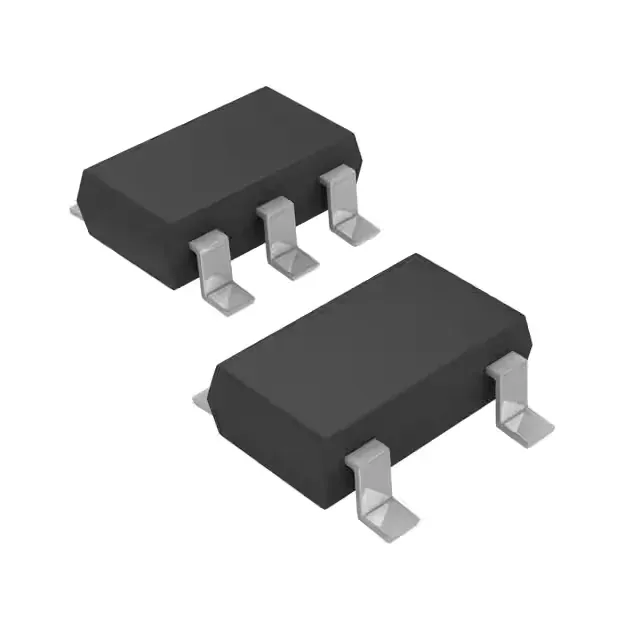
Housed in a 5-lead TSOT-23-5 (SOT-23-5 Thin), the ADP7118WAUJZ-2.5-R7 occupies roughly 3 mm × 3 mm of board area. The pinout is standard for this package family: IN, GND, EN, OUT, and a soft-start pin. The Enable and Soft Start control features let the designer sequence the rail on and control the inrush current profile — useful when the LDO feeds a capacitive load like a microcontroller core or an FPGA bank. The Tape & Reel packaging (TR) is the production-reel format; Cut Tape (CT) is available for prototyping or low-volume builds.
Availability and current pricing confirmed at RFQ.