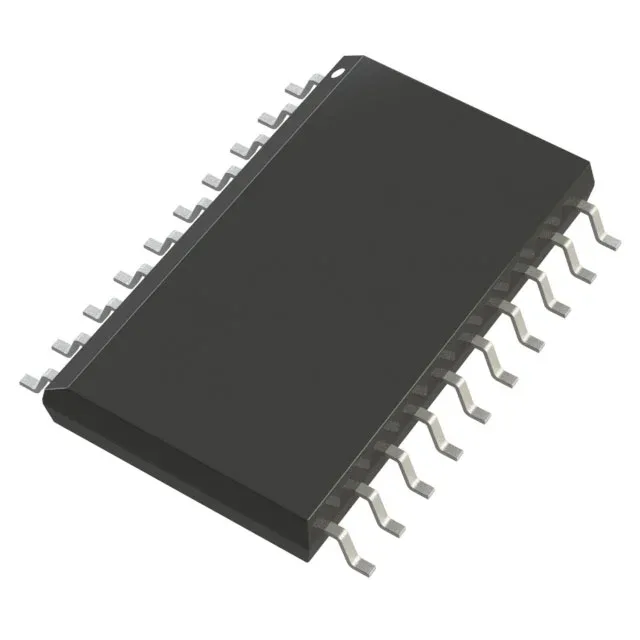
Analog Devices ADM2582EBRWZ-REEL7 — Digital Isolators
Technical Documents PDF / CAD
RoHS Compliant · Lead-Free EIA-481 Standard
Analog Devices / Digital Isolators

ADM2582EBRWZ-REEL7 Isolated RS-485 Transceiver, 16 Mbps

MPN ADM2582EBRWZ-REEL7
End of Life Spot Stock · 24-48h Dispatch 100% Original Sealed

Analog Devices ADM2582EBRWZ-REEL7, IsoPower iCoupler series, isolated RS-422/RS-485 transceiver, 16 Mbps data rate, 2500 Vrms isolation, 25 kV/µs CMTI, dual 3.3V/5V supply, -40°C to 85°C, 20-SOIC.

In Stock: 1,229 pcs
MOQ: 1 pcs
Logistics: DHL / FedEx DAP (Global Express · 3-7d) Russia & CIS DDP (Door-to-Door Cleared)
Dispatch: Shenzhen / HK
Unit Price (USD)
$12.85 / pc
Direct Purchase Ready
Volume Pricing Breaks Confirmed upon quotation
1+ pcs
$12.85
10+ pcs
$11.34
30+ pcs
$10.38
100+ pcs
$9.46
Working on a production BOM or have a target unit price? Submit Target Price
Buy Now

$12.85 / ea

1,229 in stock — maximum per order · 3–4 days lead time

$11.34 / ea from 10 pcs

Upload Full BOM List
[SPEC] Essential Parameters Snapshot Full Specifications (16)
Package / Case 20-SOIC (0.295", 7.50mm Width)
Supply Voltage 3.3V, 5V
ALT
Facing long factory lead times or allocation on ADM2582EBRWZ-REEL7? Verified pin-compatible alternatives available with active Shenzhen stock and 100% solder-ready footprint match.

Full Technical Specifications

16 Parameters
ADM2582EBRWZ-REEL7 specifications
Parameter / AttributeSpecification / Value
TypeRS422, RS485
SeriesIsoPower®, iCoupler®
Channel typeUnidirectional
MountingSurface Mount
Supply voltage3.3V, 5V
Voltage - isolation2500Vrms
Isolated powerYes
Operating temperature-40°C ~ 85°C
PackageTape & Reel (TR); Cut Tape (CT)
Data rate16Mbps
TechnologyMagnetic Coupling
Case20-SOIC (0.295\", 7.50mm Width)
Channels2
Inputs - side 1/Side 21/1
Rise (Fall time)15ns, 15ns (Max)
Common mode transient immunity25kV/µs
100% Footprint Match · Solder-Ready (No PCB Redesign Needed)

Need Stock or a Drop-in Second-Source for ADM2582EBRWZ-REEL7?

Package: SOIC-16 wide body (16-lead SOIC_W) · Pin-compatible replacements with immediate Shenzhen spot stock

Footprint Match 97%
Supply Chain & Allocation Reality:

The ADM2483 is the isolated half-duplex RS-485 transceiver of industrial Modbus loops, servo drives and PLC networks: a 2.5kV rms iCoupler barrier with true fail-safe receivers, a slew-limited driver, more than 25kV per microsecond of common-mode transient immunity, and a 16-pin wide SOIC that its 20 megabit PROFIBUS twin, the ADM2486, shares pin for pin. The substitution conversation around it has two halves: inside the 16-pin row it is a clean speed ladder, and outside it the trap is architectural - the 2483 isolates the DATA, and the bus-side supply must be isolated by the board. A repair that ties GND2 to logic ground has built a very robust non-isolated transceiver out of an expensive isolated one.

Verified Pin-Compatible Replacements (3 verified alternatives)

ADM2486 Analog Devices SOIC-16 wide body
100% Drop-in (Zero Code Change)
Availability & Target Pricing:

The 20Mbps PROFIBUS Member

Shenzhen Spot Stock (24-48h Dispatch)

Electrical & Core Specs:

The same 16-pin wide-body footprint at 40 times the data rate: 20Mbps against the 500kbps slew-limited 2483, PROFIBUS compliance, and an isolated DE status output the 2483 does not carry.

Same 3.0-5.0V logic side and the same isolated-bus-side discipline.

Compatibility & Drop-In Notes: A genuine same-socket speed upgrade for boards that moved to faster protocols; fitting the slower 2483 back into a PROFIBUS loop is the direction that fails at the protocol, not the pins.
Package & Solder Footprint: Same wide-body SOIC-16 land.
Shenzhen Warehouse Stock & MOQ: Stocked; quote the speed class against the protocol.
ADM2582E / ADM2587E Analog Devices SOIC-20 wide body
Functional Equivalent
Availability & Target Pricing:

The Integrated-Power Generation (isoPower)

Shenzhen Spot Stock (24-48h Dispatch)

Electrical & Core Specs:

The next generation folds the isolated DC-DC converter into the package (isoPower): the bus side powers itself from the logic side across the barrier - 16Mbps (2582E) or 500kbps (2587E) with the isolated rail included.

The whole point of the family: no separate isolated supply winding needed on the bus side - and the decoupling that comes with it (VISOOUT/VISOIN with their 0.1uF and 0.01uF capacitors) is part of the design.

Compatibility & Drop-In Notes: A 20-pin part is not a repair substitution for a 16-pin socket: the honest use is redesign and new boards, where the BOM shrinks by the whole isolated supply. For repairs, stay in the 16-pin row.
Package & Solder Footprint: 20-lead wide SOIC with its own decoupling network.
Shenzhen Warehouse Stock & MOQ: Stocked; the modern-design answer to the same requirement.
MAX13487 / MAX485 class (non-isolated) Maxim (Analog Devices) / multiple SOIC-8 / DIP-8
Functional Equivalent
Availability & Target Pricing:

The Reminder: Isolation Was the Part

Shenzhen Spot Stock (24-48h Dispatch)

Electrical & Core Specs:

Ordinary RS-485 transceivers - some with auto-direction convenience (MAX13487) - with no barrier at all: 8-pin parts that talk the same protocol across the same two wires.

Single supply, no isolation: the ground-loop current that the ADM2483 was bought to stop flows freely through the substitution.

Compatibility & Drop-In Notes: Auto-direction parts delete the DE timing the firmware manages on the 2483: moving between the two families is a firmware contract change on top of the electrical one. This card exists to make the deletion of the barrier visible before it happens.
Package & Solder Footprint: SOIC-8/DIP-8 against the 16-pin isolated body - different build entirely.
Shenzhen Warehouse Stock & MOQ: Universal stock; the baseline the isolated family is priced against.
Buyer & Quality Checklist for Sourcing Alternatives
  • Isolation is the function: the 2.5kV barrier and the >25kV per microsecond transient immunity are what the part was bought for in Modbus, VFD-adjacent and long-line industrial duty. A substitute without the barrier removes the reason the board survived its environment.
  • The supply half: the ADM2483 isolates DATA only - the bus-side (GND2/A/B) supply must itself be isolated on the board. A repair that bridges GND2 to logic ground turns the part into a non-isolated transceiver and re-opens every ground loop the design closed.
  • The 16-pin row is a pin-pure speed ladder: ADM2483 at 500kbps with 256-node support, ADM2486 at 20Mbps PROFIBUS grade with 50 - a drop-in upgrade with one network-margin number to check in the other direction.
  • The isoPower generation (ADM2582E/2587E) integrates the isolated DC-DC in a 20-pin body with its own decoupling requirements - a redesign route that deletes the isolated winding from the BOM, not a socket swap.
  • Bus protection is part of the transceiver repair: TVS clamps on A/B, the fail-safe bias network and 120-ohm end termination are what killed the old chip. Replace the protection with the silicon or schedule the second failure.
  • Direction control: half-duplex parts expect the firmware to manage DE/RE timing; auto-direction parts (MAX13487 class) delete that pin and its contract - moving between families is a firmware change as well as an electrical one.
Frequently Asked Technical Questions

Q: Can an ADM2486 replace an ADM2483?

A: Yes - the 16-pin wide-body parts are pin compatible: 20Mbps PROFIBUS grade against 500kbps, with an isolated DE status output added. The one number moving the other way is node support (50 against 256) - check long networks before the swap.

Q: What is the difference between the ADM2483 and the ADM2582E?

A: The 2582E family integrates the isolated power supply (isoPower) in a 20-pin package, powering the bus side across the barrier; the ADM2483 isolates data only and needs an isolated bus-side supply from the board. The 20-pin part is a design route, not a repair substitute.

Q: Can I use a MAX485 instead of an ADM2483?

A: It talks the same protocol, but it has no isolation. The 2.5kV barrier disappears, along with the ground-loop immunity the design was specified for. It is honest only where the bus was short and single-ground all along - otherwise the replacement deletes a safety function.

Technical Details & Description

Isolated RS-485 with onboard power — what it saves you

It belongs to the IsoPower and iCoupler series, using magnetic coupling for the data channels and an integrated transformer for the isolated power rail. Rated for 2500 Vrms isolation and 25 kV/µs common-mode transient immunity, it is built for industrial environments where ground potential differences and motor-drive noise would otherwise corrupt a non-isolated bus. The 16 Mbps data rate supports high-speed fieldbus links such as Profibus and RS-485-based motion control networks.

16 Mbps and 2500 Vrms — sizing the isolation for your bus

The 16 Mbps data rate is the headline figure, but the practical cable length at that speed is about 10 to 20 meters before signal degradation sets in. For longer runs — 100 m or more — you trade data rate for distance; at 500 kbps the same part can drive cables up to 1200 m. The 15 ns rise and fall times are fast enough for clean eye diagrams at 16 Mbps but also mean the layout needs controlled impedance and proper termination (typically 120 Ω across the differential pair). The 2500 Vrms isolation rating is a 1-minute withstand test voltage. For continuous use, the working voltage is derated per the datasheet curves — typically around 600 Vrms for reinforced insulation. The 25 kV/µs common-mode transient immunity means the receiver output does not glitch when a motor drive switches a 600 V IGBT in under 100 ns, which is the real-world failure mode that kills non-isolated transceivers in factory automation.

IsoPower integration — what the onboard DC-DC means for the BOM

The tradeoff is that the switching noise from the internal converter couples onto the secondary-side supply rail; the datasheet recommends an external LC filter (a ferrite bead and 10 µF capacitor) on the secondary-side Vcc if the application is sensitive to ripple. The part provides up to 30 mA of isolated output current on the secondary side, enough to power the transceiver itself and a few external pull-up resistors on the bus. If the bus requires termination resistors or bias networks that draw more than 30 mA, an external isolated supply is still needed.

For dual-sourcing considerations, the ADM2682EBRIZ-RL7 is a functional alternative with 5000 Vrms isolation and three channels (2/1), but it uses a different package (20-SOIC with wider creepage) and a different pinout — verify compatibility before substituting.

Frequently asked questions

How to replace ADM2582EBRWZ-REEL7 with a substitute?

The ADM2682EBRIZ-RL7 is a functional alternative in the same IsoPower family, offering 5000 Vrms isolation and three channels (2/1) at the same 16 Mbps data rate. However, it uses a different pinout and package — verify the layout before substituting. For a lower-speed alternative, the ADM2587EBRWZ runs at 500 kbps with the same 2500 Vrms isolation and pin-compatible footprint.

ADM2582EBRWZ-REEL7
Verified Allocation
Quote