What the 5.5 Ohm on-resistance and 35 MHz bandwidth mean for signal routing
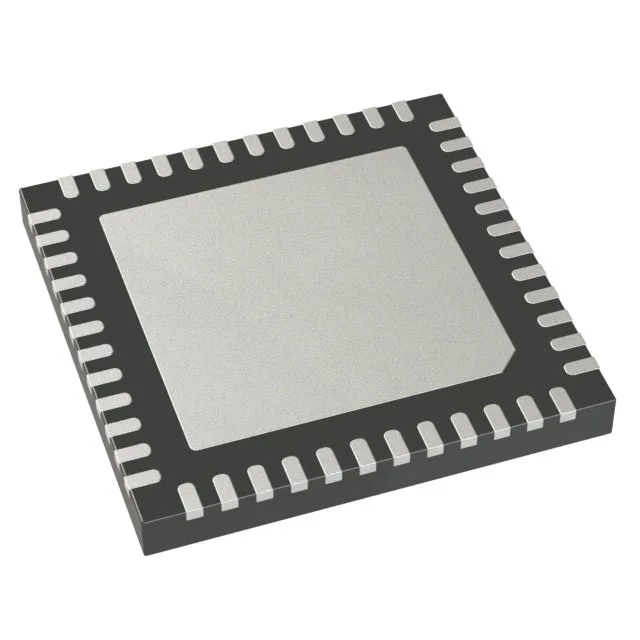
The ADG725BCPZ is a dual 16:1 multiplexer from Analog Devices, packing two independent 16-channel analog multiplexers into a single 48-LFCSP package. With a maximum on-resistance of 5.5 Ohm, the switch path adds minimal series resistance — important for maintaining signal integrity in precision analog front-ends where a few ohms of drop at the input of a high-impedance ADC can shift the reading. The -3 dB bandwidth of 35 MHz means the mux can pass signals up to the low-MHz range without significant attenuation — suitable for video, high-speed data acquisition, or multiplexing multiple sensor channels onto a shared ADC input. Crosstalk is specified at -72 dB at 1 MHz, so adjacent channels in the same package couple less than 0.025% of the signal — a figure that keeps channel-to-channel bleed below the noise floor of a 12-bit system.
Supply flexibility and charge injection
Charge injection is 1 pC typical, so the glitch when switching channels is small enough that a downstream sample-and-hold or SAR ADC with a 10 pF input cap sees a voltage step of roughly 0.1 mV — negligible in most 12- to 14-bit applications. Channel capacitance is 13 pF on the source side and 130 pF on the drain side. The higher drain capacitance is typical for a 16:1 mux — it's the shared bus capacitance that limits settling time when switching between channels. The 250 pA max leakage current means the mux won't load the signal source significantly, even at elevated temperature.
Package and board integration
The exposed pad is electrically connected to the substrate — typically tied to ground. The 0.5 mm pitch demands a PCB with at least a 4-layer stack-up for fan-out; two-layer boards will struggle to route all 48 pins without vias. The temperature range is -40°C to 85°C, covering industrial and commercial environments. The part is ROHS3 compliant and supplied in a tray — not tape-and-reel, so it's suited for prototype builds and low-volume production runs that don't need automated pick-and-place from a reel.