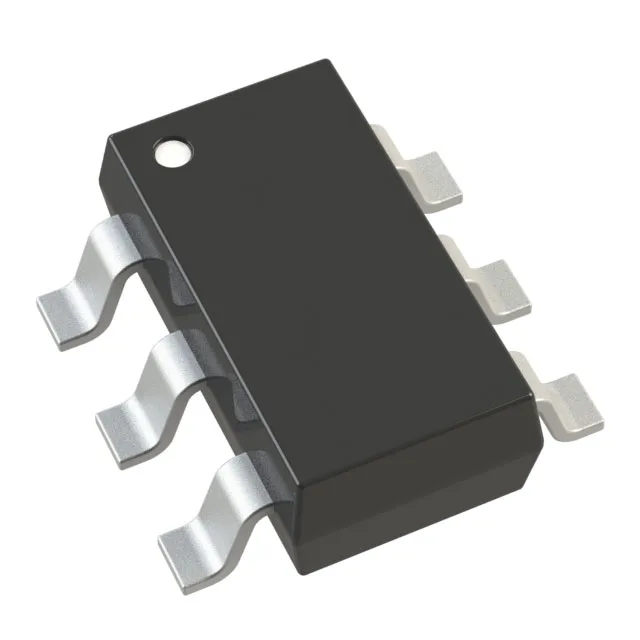
What this SPST-NC switch does on your board
It routes one signal path that stays connected when the control voltage is low and opens when the control goes high — the opposite of a normally-open switch. With a maximum on-resistance of 3 Ohm and a -3dB bandwidth of 200 MHz, it handles analog signals up to RF frequencies without significant attenuation or distortion. The 1:1 multiplexer/demultiplexer circuit means it's a straight pass-gate, not a mux. Typical applications include audio routing, video switching, data acquisition front-ends, and general-purpose signal gating in battery-powered or low-voltage systems (1.8V to 5V single supply).
3 Ohm on-resistance and 200 MHz bandwidth — what they mean for signal integrity
The 3 Ohm maximum on-resistance is low enough that a 50 Ohm system sees negligible insertion loss — roughly 0.5 dB added from the switch alone. For precision analog circuits, the flatness of RON across the signal swing matters more than the absolute value; this part is specified for 1.8V to 5V supply, so at 3.3V the RON curve stays under 3 Ohm across most of the rail. The 200 MHz -3dB bandwidth means the switch can pass a 100 MHz square wave with acceptable edge rates, making it usable for composite video, 100BASE-TX Ethernet signal routing, or high-speed comparator outputs. Below 10 MHz the insertion loss is essentially zero.
Charge injection and leakage — the analog designer's concern
Charge injection is rated at 5pC — the amount of charge dumped onto the signal path when the switch turns off. For a sample-and-hold capacitor of 10 pF, that translates to a 500 mV glitch, so this switch is better suited for AC-coupled or continuous-time paths than for precision sampled systems without external compensation. Off-leakage is typically 10pA, which keeps DC errors negligible in high-impedance circuits like photodiode amplifiers or pH probe interfaces.
Switching speed and control logic
Typical turn-on time is 12 ns, turn-off is 8 ns (max values). This sub-20 ns switching suits multiplexing in high-speed data acquisition or RF envelope control. The control logic threshold is compatible with 1.8V, 2.5V, and 3.3V CMOS logic levels when the supply is at the corresponding voltage — no level shifter needed if the control signal swings rail-to-rail. At 3.3V supply, a 3.3V logic signal drives the switch directly.
Package and mounting — SOT-23-6 footprint
The SOT-23-6 package (supplier device package same) is a 6-lead surface-mount footprint common for small-signal switches and op-amps. It measures roughly 2.9 mm x 1.6 mm — a compact outline that fits dense layouts. Cut Tape (CT) is also available for prototyping or low-volume builds.
It is ROHS3 compliant.