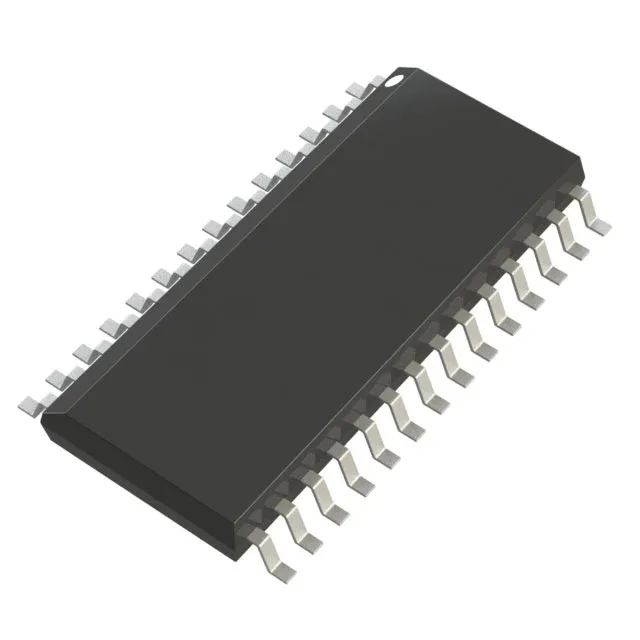
16:1 multiplexer in a 28-SOIC — what the ratings mean for the BOM
The ADG506AKRZ-REEL is a 16:1 single-ended multiplexer/demultiplexer from Analog Devices, built to route one of sixteen analog or digital signals to a common output. The 16:1 topology means it replaces sixteen individual SPDT switches or a smaller mux cascade — useful in data-acquisition front-ends where you scan multiple sensor channels into one ADC. On-state resistance is 300 Ohm max, with channel-to-channel matching held to 15 Ohm. That matching figure matters more than the absolute resistance in a precision divider or gain network — the ratio error between channels stays under 5% without calibration. Switching time is 300 ns for both turn-on and turn-off, which sets the throughput ceiling: at 300 ns settle plus the ADC acquisition time, you can scan all 16 channels in under 5 µs if the downstream converter can keep up.
Supply rails, temperature, and package — board-level fit
Runs on a single supply from 10.8 V to 16.5 V, or dual supplies from ±10.8 V to ±16.5 V. The dual-supply option lets the switch handle bipolar signals without level-shifting — the signal swing follows the rails, so ±10 V inputs pass cleanly. Rated for -40°C to +85°C ambient, which covers industrial control cabinets and outdoor telecom shelters. The 28-SOIC wide-body package (0.295-inch, 7.50 mm width) is a standard footprint — the same land pattern as many 28-pin SOIC parts, so a board spin for a second source is straightforward. Surface-mount assembly with tape-and-reel or cut-tape options. The wide-body SOIC is hand-solderable with a fine-tip iron if you are doing a field repair, but the 0.050-inch pitch demands steady hands — a hot-air station is cleaner for rework.
Leakage, charge injection, and capacitance — signal-chain impact
Off-channel leakage is 1 nA max, low enough that a 10 MOhm source impedance drops less than 10 mV of error — negligible for most 12-bit systems but worth derating for 16-bit precision where every microvolt counts. Charge injection is 4 pC typical. That is the amount of charge dumped onto the analog bus when the switch toggles — for a 100 pF sampling capacitor on the ADC input, the voltage step is 40 mV. A sample-and-hold settling time budget must include this glitch. Channel capacitance: 5 pF source-off, 44 pF drain-off. The 44 pF on the common drain loads the output node and limits the bandwidth — expect a -3 dB point around 12 MHz into a 300 Ohm load, which is fine for audio and slow-scan signals but not for video or fast serial data.
Lifecycle and compliance — active part, RoHS3, no second-source on record
Marked as Active in production and RoHS3 compliant. No official successor or cross-reference is listed — the ADG506AKRZ-REEL is the current, sole order code for this 16:1 mux in the 28-SOIC package from Analog Devices.