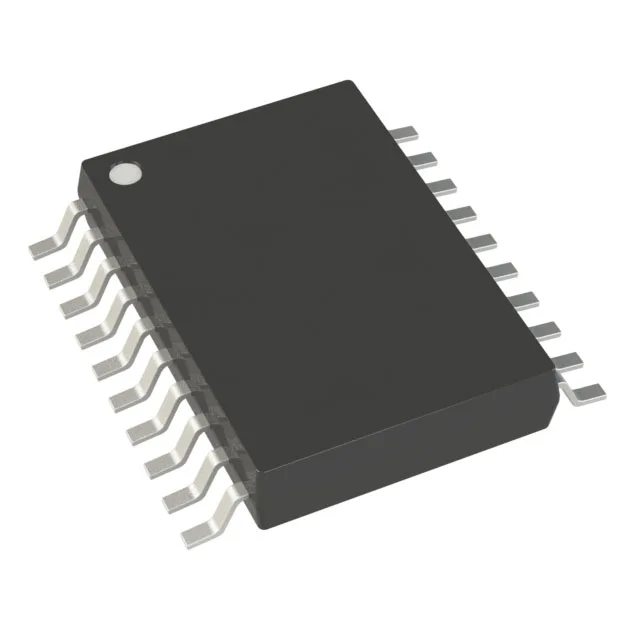
Dual SP4T analog switch for precision signal routing
The Analog Devices ADG1439BRUZ is a dual 4:1 multiplexer / demultiplexer (two SP4T switches) in a 20-TSSOP package, designed for routing analog or digital signals with minimal distortion. Each switch presents a maximum on-resistance of 11.5 ohm, with channel-to-channel matching held to 550 mOhm, keeping gain errors consistent across channels in precision instrumentation and data-acquisition front ends. The -3 dB bandwidth extends to 130 MHz, and crosstalk between channels is rated at -70 dB at 1 MHz, making the part suitable for multiplexing video, IF signals, or high-speed ADC inputs where isolation matters. Charge injection is 4 pC, low enough to avoid significant glitch energy in sample-and-hold or DAC deglitch circuits. Supply flexibility covers both single-supply operation from 5 V to 16.5 V and dual supplies from ±4.5 V to ±16.5 V, accommodating common analog rails like ±5 V, ±12 V, or ±15 V.
The 11.5 ohm max on-resistance sets the insertion loss for a given load; in a 50 ohm system the switch adds about 0.2 dB of attenuation, negligible for most analog paths. The 550 mOhm channel-to-channel matching ensures that when the mux scans multiple sensor inputs, the gain shift from one channel to the next stays under 0.05% for a 1 kohm load. Charge injection of 4 pC means that when the switch turns off, the charge dumped onto the load capacitor produces a voltage step of about 4 mV into a 1 nF hold capacitor. For a 16-bit ADC with a 5 V reference (76 µV per LSB), that step is roughly 53 LSBs — acceptable if the ADC samples after the settling time, but worth accounting for in the acquisition timing budget.
The dual-supply range of ±4.5 V to ±16.5 V lets the switch handle bipolar signals up to ±15 V without clipping, common in audio, ATE, and industrial analog I/O modules. Single-supply operation from 5 V to 16.5 V covers unipolar systems like 0-10 V PLC inputs or 12 V battery-monitoring circuits. The 20-TSSOP package (4.4 mm wide) is a standard footprint for multiplexers in this pin count, and the surface-mount assembly is straightforward with typical reflow profiles.