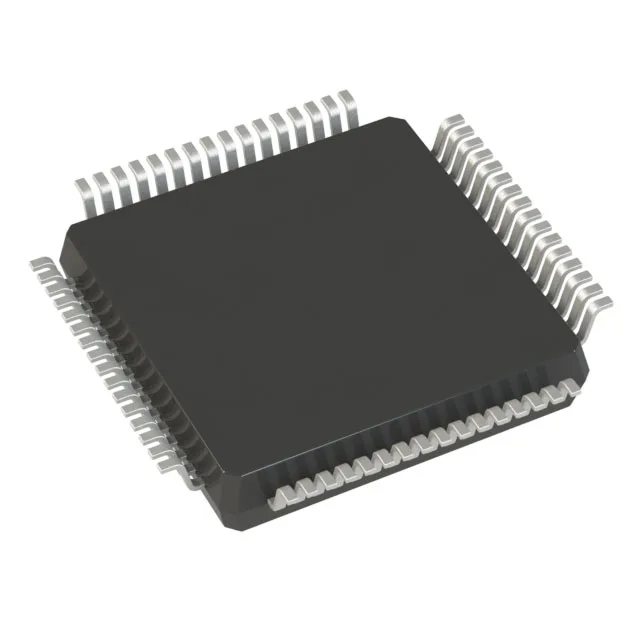
The ADAS1000BSTZ is a 5-channel, 19-bit analog front end from Analog Devices, purpose-built for electrocardiogram (ECG) and other biopotential measurement systems. It integrates the full signal chain — from electrode inputs through filtering and digitization — into a single 64-LQFP package. The 19-bit resolution gives the system enough dynamic range to capture the low-amplitude P-wave and ST-segment details that diagnostic algorithms rely on, while the 5-channel count maps directly to standard 5-lead ECG electrode configurations. The part operates from a 3.15 V to 5.5 V analog supply and a separate 1.71 V to 1.89 V digital rail, which keeps the analog front-end clean from digital switching noise when properly decoupled.
19 bits of resolution is the headline spec that separates a diagnostic-grade ECG front-end from a simple heart-rate monitor. At this depth, the ADC can resolve microvolt-level changes on the electrode inputs, which is necessary for detecting ischemia, arrhythmia, and other clinical conditions. The 5-channel count matches the limb and chest leads in a standard 5-lead ECG setup; designs that need a full 12-lead configuration typically cascade two of these devices or use the 4-channel ADAS1000-4BCPZ variant. The 64-LQFP package keeps the layout compact, but the analog and digital supply domains (3.15 V–5.5 V analog, 1.71 V–1.89 V digital) require separate rail generation and careful PCB partitioning to preserve the SNR.
We source the ADAS1000BSTZ through independent distribution channels. The part is active and widely stocked across the surplus and authorized channels.