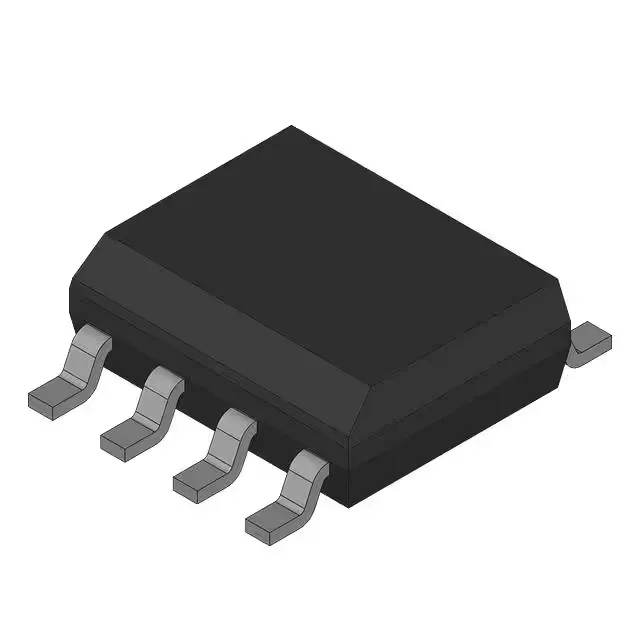
The AD9624AR-REEL is a voltage-feedback amplifier with a slew rate of 2200 V/µs (cite:) and a -3 dB bandwidth of 300 MHz (cite:). That slew rate determines how fast the output can swing under large-signal conditions — for a 5 V p-p step, the output settles in roughly 2.3 ns, limited by the slew rate rather than the bandwidth. In a pulse or transient application, the rise time is set by this figure, not the small-signal bandwidth. The differential output (cite:) pairs naturally with ADC drivers, differential line drivers, or single-ended-to-differential conversion stages where common-mode rejection matters. The single-circuit (cite:) configuration keeps the signal path clean — no adjacent channels coupling noise into the feedback loop.
Supply headroom and power budget
That is within the thermal budget of the 8-SOIC package (cite:,) for most board-level designs, but the junction temperature rise should be checked against the 85°C maximum ambient (cite:) if the amplifier is driving a heavy load continuously. Input offset voltage is 2 mV typical (cite:), and input bias current is 7 µA (cite:). For a 1 kΩ source impedance, the offset error from bias current is 7 mV — negligible in most 10-bit or 12-bit signal chains, but worth budgeting if the source impedance exceeds 10 kΩ.
Board integration and temperature grade
The AD9624AR-REEL comes in an 8-SOIC package (cite:,) with surface-mount termination (cite:). The 0.154-inch body width is standard — the footprint matches any SOIC-8 land pattern. Bulk packaging (cite:) means loose tubes or trays, suitable for prototyping, rework, or low-volume production where a reel is unnecessary.
Active lifecycle and cross-reference reality
No official second-source or pin-compatible drop-in replacement is documented by the manufacturer, so the BOM line should be treated as single-sourced for this footprint. A direct PCB drop-in is not guaranteed without layout changes.