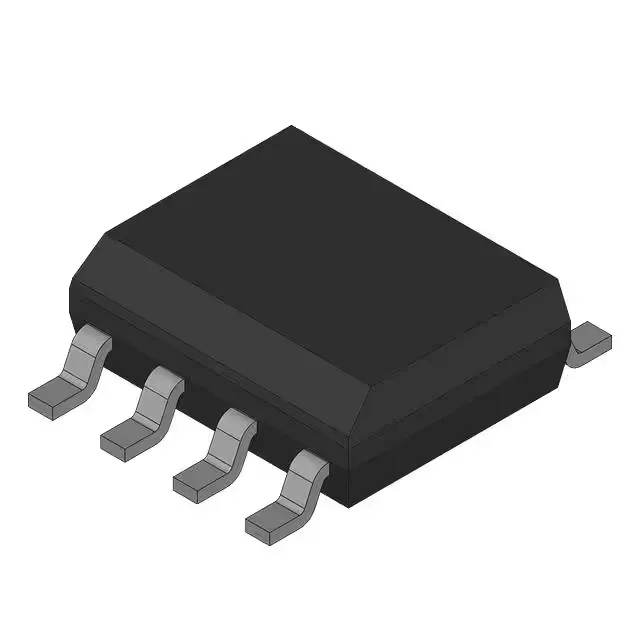
That combination puts it in the class of fast op-amps used for video distribution, high-speed ADC drivers, and pulse amplifier stages where settling time matters. It runs on a supply span from 9 V to 36 V, drawing 5.1 mA quiescent current. The 8-SOIC package is surface-mount, so it fits on a standard PCB without special handling — no lab, no bench, just a reflow profile.
A 300 V/µs slew rate means this op-amp can swing its output by several volts in a few nanoseconds. For a 5 V peak-to-peak output step, the rise time is roughly 17 ns. That is fast enough to handle 10 MHz sine waves with negligible distortion, and it keeps the signal clean when driving the input of a high-speed ADC or a video cable.
That means it is intended for indoor, office, or lab equipment — not for a motor drive sitting in a factory bay, not for under-hood automotive. If your application lives in a conditioned space, this temperature grade is fine. For anything that sees freeze-thaw or a hot enclosure, you would need an industrial or military-grade sibling.
That is a constraint for any BOM that must meet RoHS exemption limits. For new designs requiring lead-free assembly, the AD847JRZ-REEL7 is a functional peer with similar speed (300 V/µs slew rate, 50 MHz GBW) and is available in lead-free finish.