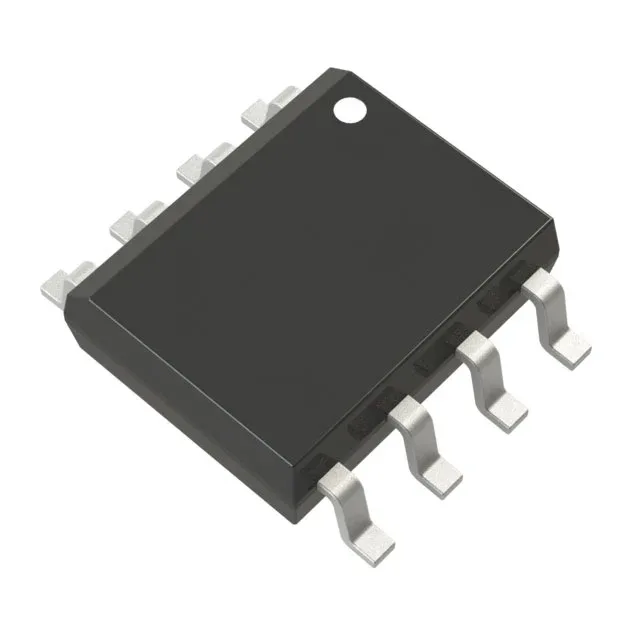
JFET op-amp for precision analog signal chains
Supply span runs from 9 V to 36 V total, so it works on ±5 V to ±18 V split rails or a single 12 V/24 V rail without an extra regulator.
At 20 V/µs the AD711JRZ can track a 10 V peak-to-peak sine wave up to roughly 318 kHz before slew-rate limiting sets in — adequate for audio processing, data acquisition front-ends, and control-loop compensation in switching power supplies. The 4 MHz -3 dB bandwidth supports moderate-speed filtering and anti-aliasing stages; for faster pulse work or video, a wider-bandwidth JFET op-amp like the AD823 (16 MHz) would be the next tier up. The 300 µV input offset is untrimmed; if sub-100 µV offset is needed, the AD711KRZ variant specifies 200 µV max.
It belongs in bench instruments, office equipment, consumer audio, and indoor telecom line cards — not in engine bays, outdoor enclosures, or factory-floor motor drives where the ambient can push past 70°C. For extended industrial or automotive environments, look at the AD711JRZ's industrial-temperature sibling (AD711BQ, -40°C to +85°C) if the rest of the BOM can tolerate a DIP or SOIC-8 package change.
Package, supply, and lifecycle
If your pick-and-place line prefers tape-and-reel, the AD711JRZ-REEL7 is the same die in a 7" reel carrier. Supply range spans 9 V to 36 V total, covering single-supply 12 V or 24 V systems and split ±5 V to ±18 V rails.