Active production — still a current BOM line
The AD533JD: RoHS non-compliant: the part uses lead-bearing solder terminations, so it belongs in legacy assemblies that have not migrated to lead-free reflow profiles. A RoHS-exempt or military-class board that explicitly allows SnPb solder is the correct home.
What a 4-quadrant multiplier/divider actually does in the signal chain
This is a 4-quadrant analog multiplier/divider — it takes two analog inputs and outputs their product (or quotient with an external op-amp), with sign handling across all four voltage polarities. In a control loop, that means it can compute real power (V × I), modulate gain, or perform analog division for ratiometric measurements without a digital processor in the path. The 4-quadrant capability distinguishes it from two-quadrant multipliers: the output sign tracks both inputs correctly even when one or both go negative, which matters for AC-coupled signals or bipolar sensor outputs.
14-CDIP window package — hermetic seal with UV-erasable window
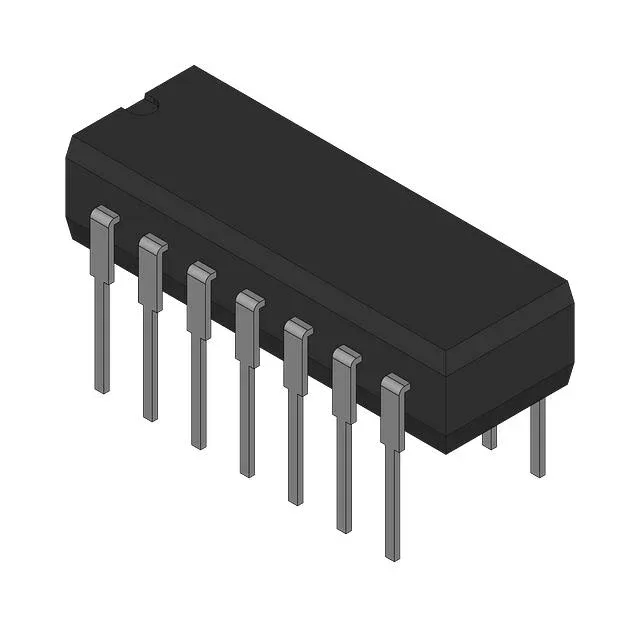
Housed in a 14-lead ceramic dual-in-line package (CDIP) with a UV-transparent window over the die cavity. The ceramic body provides a hermetic seal — moisture ingress is negligible compared to plastic — and the window allows the die to be erased under UV light if the internal trim or calibration is stored in an on-chip floating-gate array. The 0.300-inch body width is the standard narrow DIP footprint; it drops into a 14-pin socket or through-hole PCB layout. Bulk packaging means it ships in tubes or trays, not tape-and-reel — consistent with low-volume or high-reliability procurement.
Peer parts — same function, different temperature grades
Three peers share the same 4-quadrant multiplier/divider core and bulk packaging: AD533LH, AD533SH, and AD533LD. The difference is the temperature screening — the 'H' and 'S' suffixes typically indicate wider military or industrial temperature ranges, while the 'D' suffix (as on AD533JD) is the commercial/industrial grade. All four are pin-for-pin compatible in the same 14-CDIP footprint, so swapping between them is a BOM temperature-grade decision, not a board-spin.
Sourcing the AD533JD for a production run or repair
Because the part is active, there is no last-time-buy deadline to track, but the RoHS non-compliant status means buyers should verify their assembly house can still run SnPb profiles.