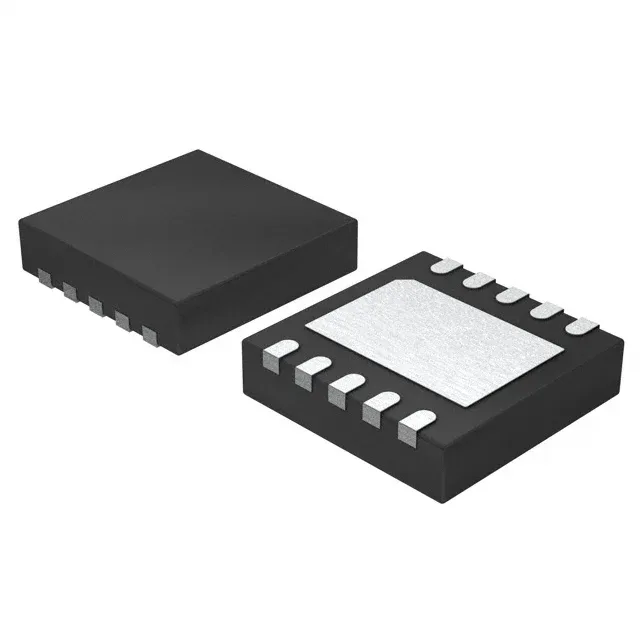
Package and integration story
The AD5274BCPZ-20-RL7 is a 20 kOhm digital rheostat in a 10-lead LFCSP-WD (3x3 mm) package — the exposed paddle underneath is the thermal path, not a signal connection, so the board footprint needs a thermal via array under the pad to pull heat into the ground plane. The 0.5 mm pitch demands a soldermask-defined pad and a reflow profile that matches the lead-free paste; a hot-air rework station with a fine nozzle is the safe removal method. The I2C interface runs on two wires (SDA, SCL) with the address set by a logic-level pin — the Selectable Address feature lets up to two of these share the same bus without a multiplexer, as long as the address pin is tied high or low. Pull-up resistors to the supply rail are required on both lines; the 400 kHz standard-mode clock is fine for the 256-tap write cycle.
What the 256 taps and 5 ppm/°C tempco mean for your circuit
256 taps across 20 kOhm gives a step size of about 78 ohms — fine enough for trimming a voltage divider or setting a bias current in a feedback loop, but too coarse for precision setpoints where a 1% resistor tolerance already eats half the step. The 5 ppm/°C temperature coefficient means the end-to-end resistance drifts about 0.1 ohm per degree C — negligible in a lab environment but worth budgeting in an engine bay that sees 105°C ambient. The wiper resistance is 35 ohms typical — at the lowest code (wiper at the B terminal) the total resistance is 20 kOhm plus 35 ohms, which is a 0.175% error. At mid-scale the wiper resistance is a smaller fraction of the total, but in a rheostat configuration the wiper resistance adds directly to the series path, so a 35-ohm offset matters if the circuit expects a true zero-ohm minimum.
Lifecycle and compliance — still active, no end-of-life watch
The tape-and-reel packaging (7-inch reel, 3000 pieces per reel) is the standard carrier for the LFCSP package — the embossed pocket protects the exposed pad from mechanical damage during shipping. Cut-tape quantities are available for prototyping.
How it compares to the AD5274BRMZ-20 and AD5272BRMZ-20-RL7
The AD5274BRMZ-20 is the same die in an MSOP-10 package — same 256 taps, same 20 kOhm, same I2C interface, but the MSOP has no exposed pad and a different pinout. The AD5274BCPZ-20-RL7 will not drop into a board laid out for the BRMZ without a footprint change; the LFCSP's thermal pad needs a different land pattern and via placement. The AD5272BRMZ-20-RL7 offers 1024 taps instead of 256 — four times the resolution for finer adjustment — but uses the same I2C protocol and the same 20 kOhm range. The trade-off is a longer write time per tap (the 1024-step part takes more clock cycles to load the full register) and a slightly higher cost per unit. For a trimming application that only needs 1% accuracy, the 256-tap AD5274 is sufficient; for a precision calibration loop, the 1024-tap AD5272 is the better fit.