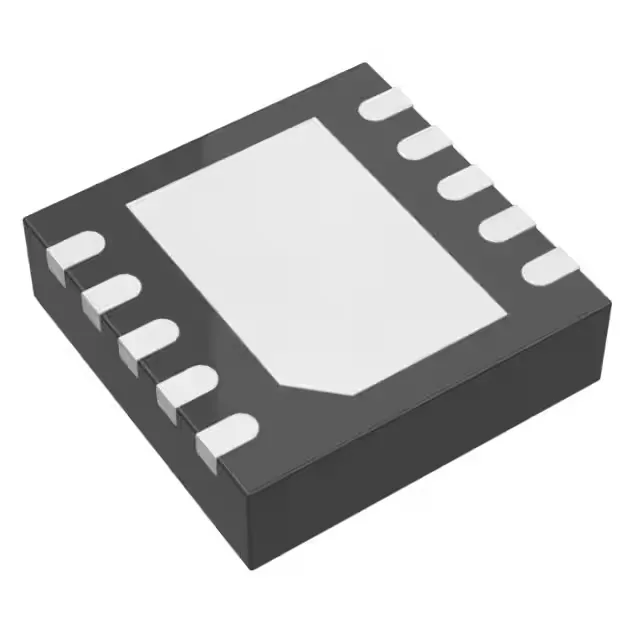
Package and board-fit — 10-LFCSP-WD (3x3)
The AD4007BCPZ-RL7 comes in a 10-lead LFCSP-WD with an exposed pad, 3x3 mm footprint. The thermal pad on the underside needs a solid ground-plane connection and a via array under the package to pull heat out of the die — the datasheet's recommended land pattern shows the via pitch and solder-mask opening. The 0.50 mm lead pitch is fine for a two-layer board if the fan-out is planned around the central pad.
18-bit SAR core at 1 MSPS — what the speed means for the signal chain
This is a successive-approximation-register (SAR) ADC, 18-bit resolution, sampling at 1 MSPS. The 1 MSPS throughput is the conversion rate including acquisition — the actual aperture delay and conversion time determine how many channels you can scan in a multiplexed front-end. With a single differential input, the 1 MSPS is the per-channel rate; no mux overhead to budget. The differential input architecture rejects common-mode noise from the sensor or signal chain, which is useful when the source is remote or the ground reference drifts. The external reference input lets you set the full-scale range to match the signal amplitude — a 2.5 V reference gives a 5 Vpp differential span, while a 4.096 V reference gives 8.192 Vpp, so you can align the ADC range to the sensor output without a gain stage.
Supply rails and digital interface flexibility
The SPI-compatible interface also supports DSP, MICROWIRE, and QSPI protocols, so it mates with most MCU SPI peripherals and FPGA soft cores.
Temperature grade and deployment envelope
The 125°C ceiling covers under-hood automotive sensor interfaces, downhole instrumentation, and motor-drive feedback paths where the ambient near the heatsink hits 105°C. The LFCSP package's exposed pad helps keep the junction temperature below the 150°C absolute maximum when the board is in a hot enclosure.