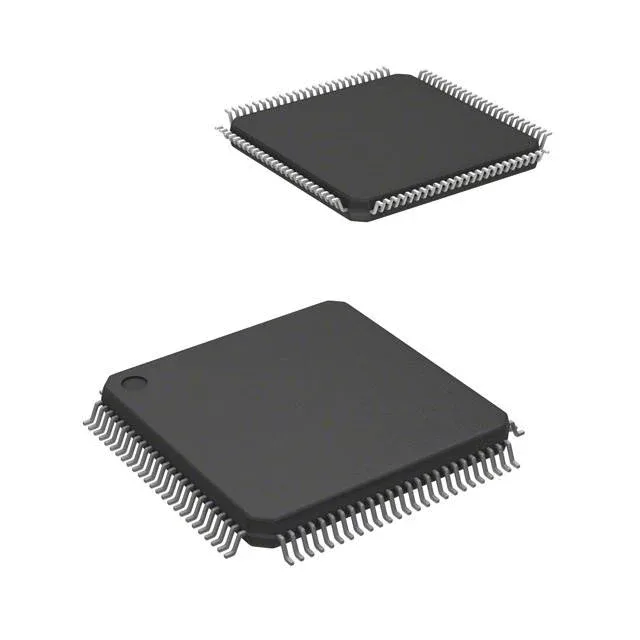
80 MHz Cortex-M4F with FPU — what it buys you on the control loop
That FPU matters for motor-control FOC loops, sensor fusion, and digital filter math — the hardware handles transcendental and division operations in fewer cycles than a software-emulated M3 or M4 without FPU. The 128 KB Flash and 32K x 8 RAM footprint fits moderate-complexity firmware: a CANopen stack plus a PID loop and a Modbus RTU slave, for example, without squeezing. The 2K x 8 EEPROM holds calibration constants and boot-config parameters that survive a firmware update.
Industrial temperature grade and connectivity
The peripheral set includes CANbus, I²C, SPI, SSI, UART, and QEI — the quadrature encoder interface is a direct fit for reading incremental encoder position in a servo axis without external logic. The 22-channel 12-bit ADC on board handles current sensing on three motor phases plus a few analog inputs for temperature and voltage monitoring. Brown-out detect and POR are integrated, so a separate supervisor IC is optional for most designs.
100-LQFP package — board fit and routing
The 100-LQFP (14x14 mm) gives 69 general-purpose I/O. That is enough for a parallel LCD data bus, encoder channels, CAN and UART transceiver control, and pushbutton/LED lines on a 4-layer board.