That FPU is the main differentiator versus a plain Cortex-M3 — single-cycle MAC and divide for sensor fusion or motor-current loops without software emulation overhead. The 128 KB Flash and 32 KB SRAM fit a CANopen or Modbus RTU stack plus a modest control loop; the 22-channel 12-bit ADC covers multi-sensor acquisition without an external mux.
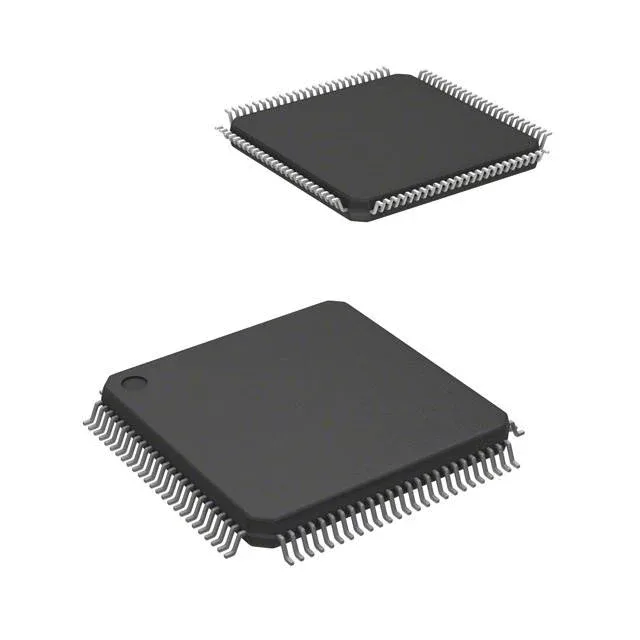
128 KB Flash and 32 KB SRAM in a 100-LQFP package. A CANopen master stack fits; a full EtherCAT stack does not.
On-chip CAN 2.0B controller (with external transceiver) connects directly to industrial fieldbus or automotive powertrain networks. The peripheral set includes I²C, SPI, SSI, UART, IrDA, Microwire, QEI for quadrature encoder feedback, and a motion-PWM timer set for BLDC or stepper drive. Brown-out reset, POR, and watchdog are integrated — no external supervisor needed for basic safety monitoring.