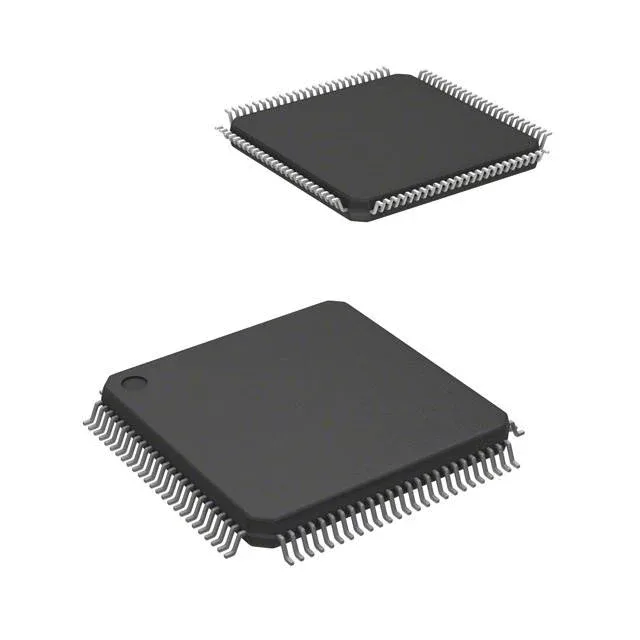
What this 16-bit MCU brings to the board
The Texas Instruments MSP430F6725AIPZR is a 16-bit MSP430 CPUXV2 microcontroller running at 25 MHz, with 128 KB of Flash program memory and 4 KB of RAM. It sits in a 100-pin LQFP package (14×14 mm) with 72 general-purpose I/O lines. The part is built for mixed-signal control applications where on-chip precision measurement and a local display matter — it integrates a dual 24-bit sigma-delta ADC alongside an 8-channel 10-bit ADC, plus a segment LCD driver that can run a simple alphanumeric panel without an external display controller.
The CPUXV2 pipeline at 25 MHz executes most instructions in a single cycle. The peripheral clock tree divides from the main clock for I²C and SPI.
128 KB Flash and 4 KB RAM — sizing the firmware and data buffer
128 KB of Flash is generous for a 16-bit MCU in this class — enough to hold a Modbus RTU stack, a segmented LCD driver library, and a moderate application state machine with room for field-upgradeable firmware. The 4 KB RAM is the tighter resource; it limits the size of DMA buffers and the number of active sigma-delta conversion results you can hold before offloading to Flash. For designs that stream 24-bit ADC data at high rates, plan the buffer footprint against the 4 KB ceiling early in the firmware architecture.
Dual 24-bit sigma-delta ADC — the part's standout feature
Two independent 24-bit sigma-delta ADCs are unusual on a 16-bit MCU. They are intended for direct sensor connection — strain gauges, thermocouples, pressure transducers — without an external analog front-end. The 8-channel 10-bit ADC handles the faster, lower-resolution channels (current sensing, potentiometer feedback) while the sigma-delta channels take the precision measurements. The 24-bit converters are not fast (typical conversion rates in the tens to low hundreds of samples per second), but the noise floor is low enough for weigh-scale and flow-meter accuracy classes.
LINbus support makes this part a candidate for automotive sub-bus nodes (window lifts, seat controllers) in the 85°C cabin environment. IrDA is useful for contactless data-dump in metering or medical equipment where a sealed enclosure needs occasional firmware retrieval. The brown-out reset and programmable watchdog timer are standard for industrial reliability — the DMA controller can move ADC results to RAM without CPU intervention, which helps keep the 4 KB RAM utilisation efficient.