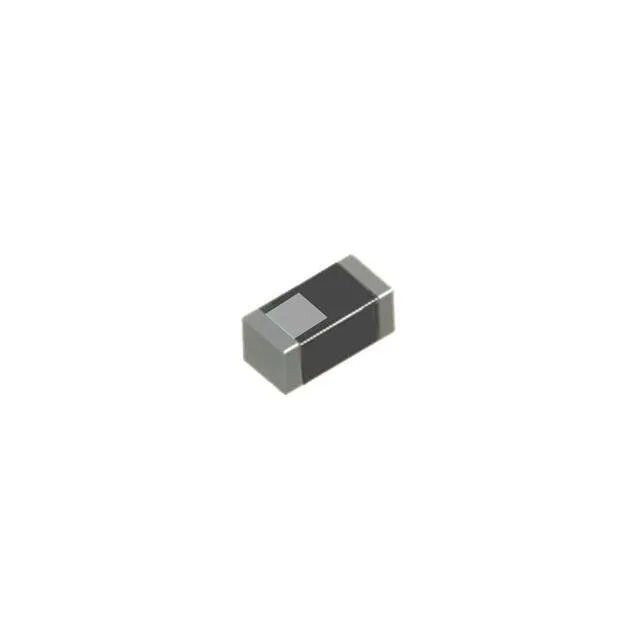
330 nH, 3.3 A — the power rail decoupling workhorse
The LBCNF1608KKTR33MAD is a multilayer inductor from Taiyo Yuden's LBCN series, built with a metal core and rated for 330 nH at ±20% tolerance. Its 3.3 A continuous current rating and 46 mOhm max DCR make it a fit for DC-DC converter output filtering where low DC loss matters more than high-frequency Q. The saturation current is 2.8 A — the inductance rolls off above that point, so the 3.3 A rating is the thermal limit, not the linear-region ceiling. For a buck converter output rail, the peak inductor current should stay below 2.8 A to keep the inductance within 10% of nominal.
Metal core, wide temperature range
The metal core material gives this inductor a flat inductance-versus-current curve compared to ferrite — the saturation knee is softer, so it handles DC bias without the abrupt drop a ferrite bead would show. In the 0603 (1608 Metric) package, the seated height is 1.00 mm max — low enough for tight card-edge clearance in a multi-layer PCB stack. The unshielded construction means the stray field couples into adjacent traces; keep sensitive analog routing at least two package widths away.