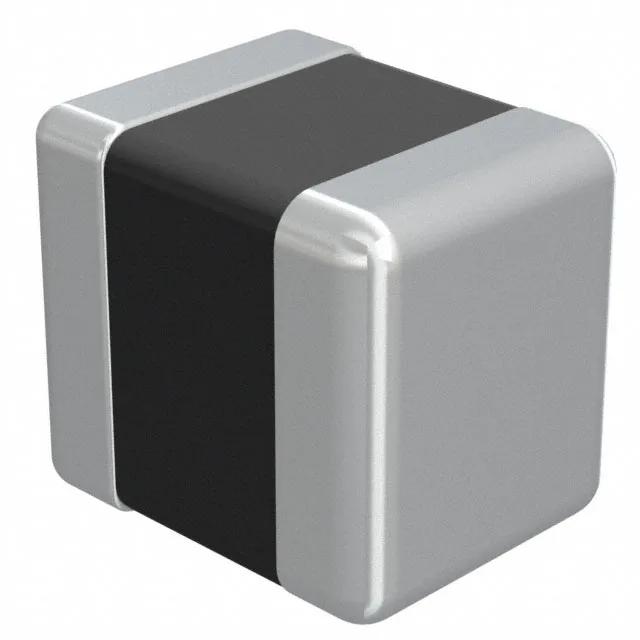
What the 6.8 µH and 290 mA rating mean for your board
The LBC2016T6R8M: The 6.8 µH inductance at 7.96 MHz test frequency is the value used for filter cutoff or DC-DC inductor selection — the ±20% tolerance means the actual inductance can range from 5.44 µH to 8.16 µH, so a filter with a tight corner frequency needs a tighter-tolerance part. The 290 mA current rating is the DC bias current at which the inductance typically drops 10–20% due to core saturation — derate to 70% for continuous operation, so plan for about 200 mA max in a power rail. 590 mOhm DCR at 290 mA gives a conduction loss of I²R ≈ 50 mW — negligible for most boards, but in a dense 0806 layout the self-heating adds to the ambient temperature, and the part is only rated to 105°C.
Unshielded construction — what it means for EMI
This is an unshielded drum-core inductor — the magnetic field radiates from the open side of the core. On a two-layer board, keep sensitive analog traces or high-impedance nodes at least 2–3 mm away from the inductor footprint to avoid coupling noise. The self-resonant frequency is 38 MHz — above that frequency the inductor behaves capacitively, so it is not suitable for filtering or energy storage in circuits switching above ~10 MHz.
NRND — what it means for your BOM
Existing production BOMs can still be filled through independent distribution, but the manufacturer is not guaranteeing long-term availability. Plan a qualification cycle for a replacement before the next board spin. The 0806 (2016 Metric) footprint is a standard size shared by many inductor families — a drop-in replacement from another Taiyo Yuden LB series variant or a competitor like Murata or TDK is likely, but the unshielded construction and 6.8 µH / 290 mA / 590 mOhm must match.