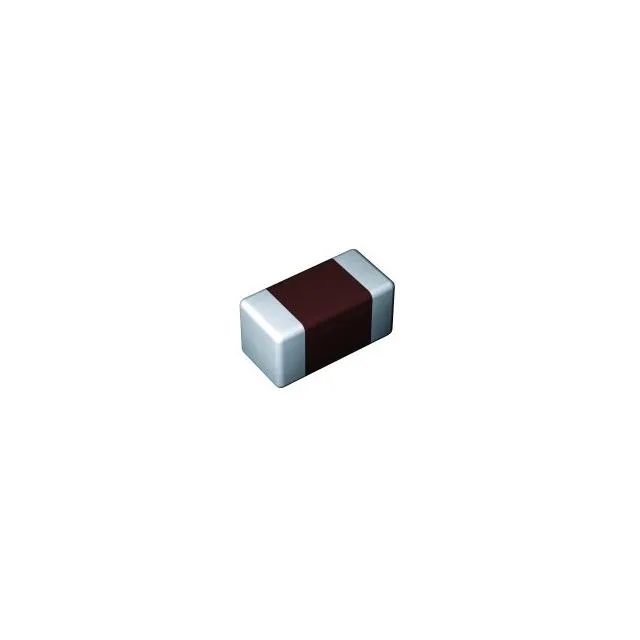
Rated 6.3 Vdc, the JMK105C6225KV-F sits at the low end of the standard MLCC voltage ladder for 2.2 µF in 0402 — a board designed around 5 V rails can use it without derating concerns, but the same 2.2 µF part bumped to 10 V or 16 V is the correct choice for any rail operating near 6.3 V. The capacitance is 2.2 µF, sufficient for local bypassing on low-current rails but not the bulk-hold role a 10 µF or larger film device plays further downstream.
X6S over X5R — what the temperature coefficient means for decoupling
The X6S dielectric specifies capacitance drift within ±15% across the full -55 to 105 °C range — a meaningful window for automotive interior or industrial equipment that sees cold soak and thermal cycling. An X5R at the same capacitance and voltage rating typically holds tighter initial tolerance but drifts comparably across temperature; the practical difference on a decoupling node is noise budget, not derating failure. The operating range bottoms at -55 °C, which covers cryo-adjacent industrial enclosures and outdoor-telemetered nodes that are not quite cold enough for an NPO/COG grade.
0402 footprint, 0.55 mm max — thin board and hand-assembly reality
The 1.00 mm × 0.50 mm body with a 0.55 mm thickness ceiling places this firmly in the compact-mobile class. The 0402 (1005 Metric) land pattern is the standard pre-BGA pad size — a hot-air tip or fine-tipped iron handles it without a reflow oven if the pad finish is ENIG or HASL; OSP boards are harder to rework without a preheater because the pads oxidise under local heat.
±10% tolerance — BOM risk for the analog path, fine for SMPS filtering
The ±10% initial tolerance is the standard MLCC grade for power supply decoupling, and for a 2.2 µF bypass cap the swing is acoustically negligible. For a reference or integrating ADC supply, the same tolerance applied to a 2.2 µF X6S capacitor yields a reactance variation that pushes phase margin on a LDO beyond what the datasheet guarantees — the fix is a COG (NPO) or film part in the signal chain, leaving this device for bulk and local decoupling where it belongs. The SMPS filtering application designation aligns with that split: this is the right part on the input or output rail of a switcher, not the sensitive analog island.