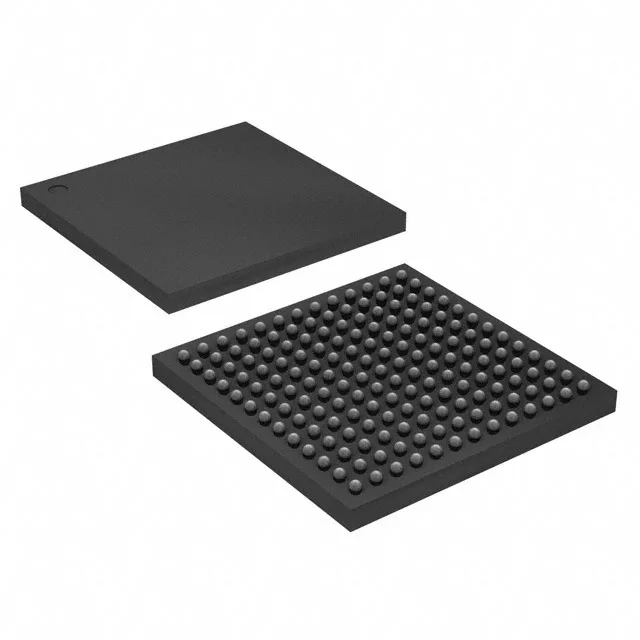
STM32F437AIH6TR — STM32F4 ARM Cortex-M4 MCU, 180MHz, 2MB Flash, 169-UFBGA
STMicroelectronics STM32F4 series, STM32F437AIH6TR: 32-bit ARM Cortex-M4 single-core at 180MHz, 2MB Flash, 256KB RAM, Ethernet + CANbus, USB OTG, 114 I/O, 169-UFBGA (7x7mm) Tape & Reel, 1.8–3.6 V supply, -40°C to 85°C. Lifecycle stage: end-of-life.
Specifications
| Parameter | Value |
|---|---|
| Series | STM32F4 |
| Mounting | Surface Mount |
| Oscillator type | Internal |
| Program memory type | FLASH |
| Voltage - supply (Vcc (Vdd)) | 1.8V ~ 3.6V |
| Operating temperature | -40°C~85°C(TA) |
| Speed | 180MHz |
| Package | Tape & Reel (TR) |
| RAM size | 256K x 8 |
| Core size | 32-Bit Single-Core |
| Peripherals | Brown-out Detect/Reset, DMA, I²S, LCD, POR, PWM, WDT |
| Connectivity | CANbus, EBI/EMI, Ethernet, I²C, IrDA, LINbus, SPI, UART/USART, USB OTG |
| Number of i (O) | 114 |
| Core processor | ARM® Cortex®-M4 |
| Case | 169-UFBGA |
| Data converters | A/D 24x12b; D/A 2x12b |
| Program memory size | 2MB (2M x 8) |
Frequently asked questions
Can we drop-in swap the STM32F437AIH6TR with the STM32F437VI (LQFP-100) or does the 169-UFBGA require a PCB respin?
No drop-in swap is possible. The STM32F437AIH6TR is packaged in 169-UFBGA; the STM32F437VI uses LQFP-100 — different pinout, different package footprint, different ball map. A board routed for LQFP cannot accept a UFBGA without a full layout respin, new prototype build, and re-certification. Verify the base board's package before committing this part to a BOM line.
Our panel runs at 85 °C ambient — does the -40°C~85°C rating leave thermal headroom at 180MHz full clock?
The 85°C ambient rating at 180MHz is the limiting case for this part in enclosed industrial panels. The 169-UFBGA has minimal PCB copper spread for heat dissipation, so running at full 180MHz clock near the upper temperature limit is the worst-case thermal scenario. Clock reduction or additional thermal management on the board is the standard path for sustained high-ambient deployments; consult the ST datasheet thermal resistance section for the exact derating curve.