Dual-core architecture for mixed-criticality workloads
The R9A07G043U11GBG#BC0 pairs a 1 GHz quad-core ARM Cortex-A55 application cluster with a 200 MHz Cortex-M33 real-time core on a single die. The A55 cluster runs Linux or an RTOS for high-level application logic, while the M33 handles deterministic control loops and safety monitoring without competing for cache or bus bandwidth. The Cortex-A55 cluster includes NEON SIMD coprocessors for multimedia and signal-processing acceleration, though the part has no dedicated graphics engine — display output is handled through the LCD controller, not a GPU.
Memory and peripheral selection for edge-compute gateways
The integrated memory controller supports both DDR4 and DDR3L, giving the board designer a cost-versus-performance choice: DDR3L for legacy BOMs or DDR4 for higher bandwidth and lower voltage. The 64-bit bus width matches the A55 cluster's data throughput. Networking is covered by dual Gigabit Ethernet MACs and dual USB 2.0 interfaces — enough for a dual-port industrial gateway or a protocol converter with local device connectivity. The CANbus interface extends into vehicle or factory-floor fieldbus domains. Storage interfaces include eMMC, SD/SDIO, and SPI — the eMMC path is the primary boot and root-filesystem media; the SDIO slot can serve Wi-Fi modules or removable storage.
Industrial temperature and security for unattended edge nodes
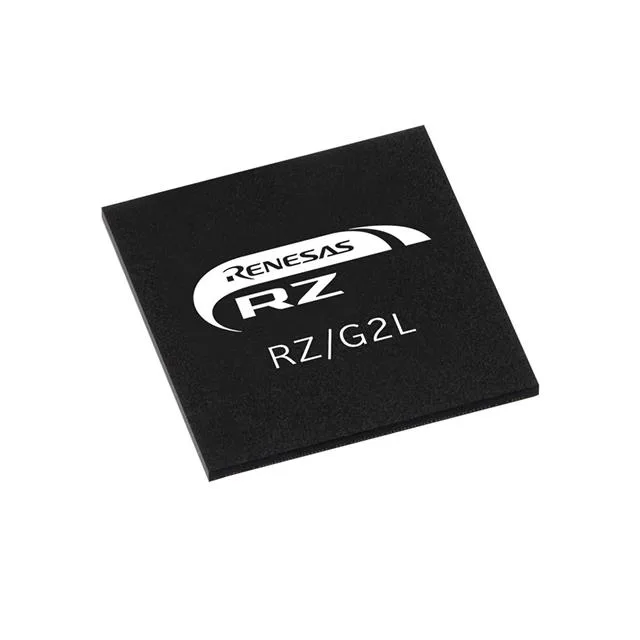
The 361-ball BGA (13x13 mm) keeps the footprint compact for 4- to 6-layer PCBs. On-chip security hardware accelerates AES-128/256, ECC, SHA-1/224/256, GHASH, and RSA, plus a true random number generator.
Active production and compliance status
The surface-mount BGA package requires standard reflow profiling per JEDEC J-STD-020; no special handling beyond MSL moisture sensitivity as marked on the reel.