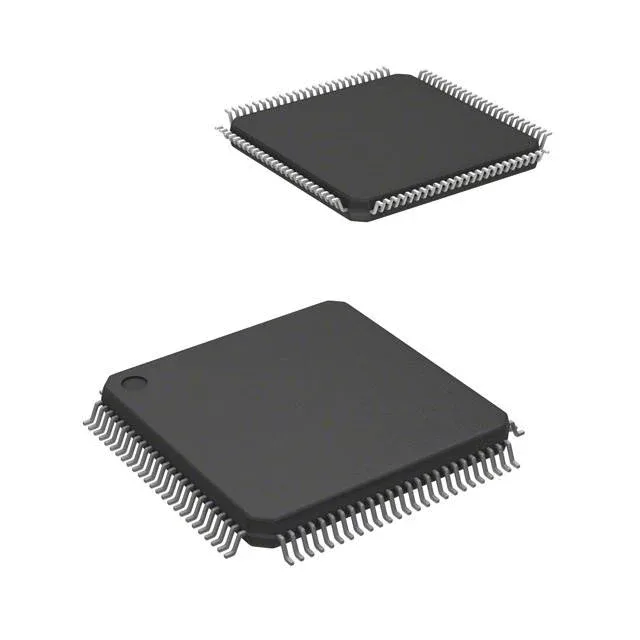
The NXP LPC1549JBD100K is a 32-bit ARM Cortex-M3 MCU running at 72 MHz, with 256 KB of Flash program memory, 36 KB of SRAM, and 4 KB of on-chip EEPROM. That memory split covers moderate firmware images and leaves room for a small parameter store without external EEPROM. The 72 MHz clock delivers enough throughput for real-time control loops, Modbus polling, and basic signal processing — it is not a high-end DSP replacement, but it handles most industrial sensor and actuator tasks.
Peripheral set and industrial connectivity
This MCU integrates CANbus, USB, I²C, SPI, and UART interfaces — the CAN and USB are the key differentiators versus smaller LPC15xx siblings. The 24-channel 12-bit SAR ADC and single 12-bit DAC reduce external analog front-end components for multi-sensor inputs and analog output loops.