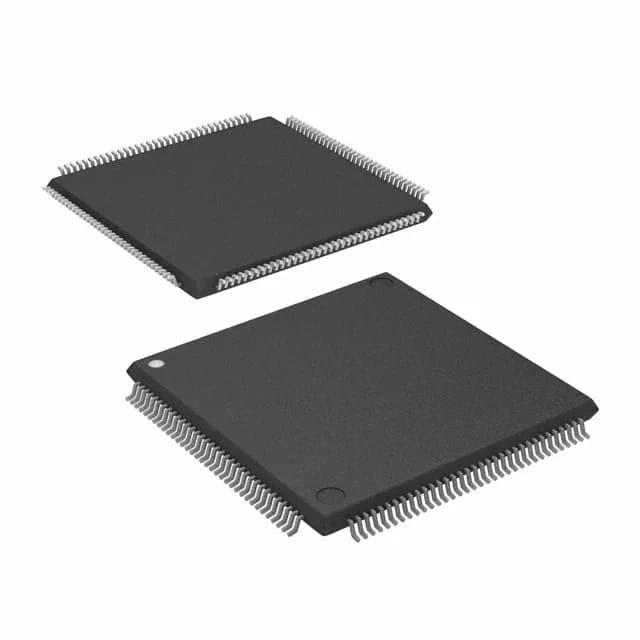
120 MHz Cortex-M3 — what it means for the control loop
The 120 MHz core clock gives this MCU enough headroom to run a real-time control loop, handle protocol stacks (CAN, USB), and service interrupts without stalling. For a motor-drive or multi-axis controller, that clock rate supports PWM update rates in the tens of kilohertz and fast fault-response latencies. The 40 KB SRAM is sized for moderate data buffers and stack depth — enough for a CANopen node or a small HMI panel, but not for large frame buffers or extensive data logging without external memory.
Connectivity and I/O — BOM simplification
With USB OTG, CAN, and an external bus interface (EBI/EMI) on-chip, this MCU can serve as a gateway between a fieldbus (CAN) and a host PC (USB) without extra bridge ICs. The 109 I/O lines in a 144-LQFP footprint mean most designs can avoid port expanders.