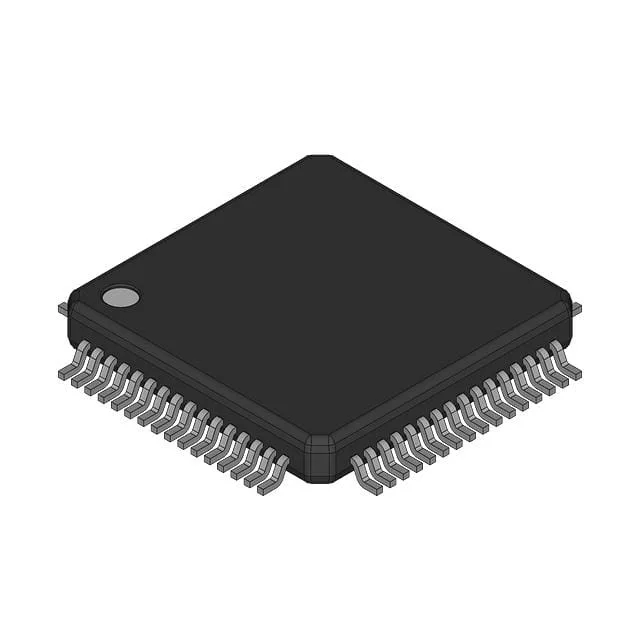
The NXP LPC11E67JBD64551 is a 32-bit ARM Cortex-M0+ microcontroller from the LPC11Exx series, clocked at 50 MHz. This is a general-purpose control MCU sized for industrial sensor nodes, motor-control front ends, and human-machine interface panels where you need the Cortex-M0+ efficiency and a wide temperature range.
50 MHz — what it buys you on the bus
The 50 MHz core speed is the headline processing ceiling. For a Cortex-M0+, that is enough to run a Modbus RTU stack, handle a PID loop, or poll ten ADC channels and log to Flash without dropping samples.
Memory layout: Flash, RAM, and the 4 KB EEPROM
The 20 KB SRAM gives you room for a couple of moderate-size buffers. The 4 KB EEPROM stores calibration coefficients, node addresses, and fault logs without wearing the Flash or adding an external EEPROM IC.
Industrial temperature range and peripherals
On-chip brown-out detect, POR, and a watchdog timer give you supervised startup and fault recovery without external reset ICs.