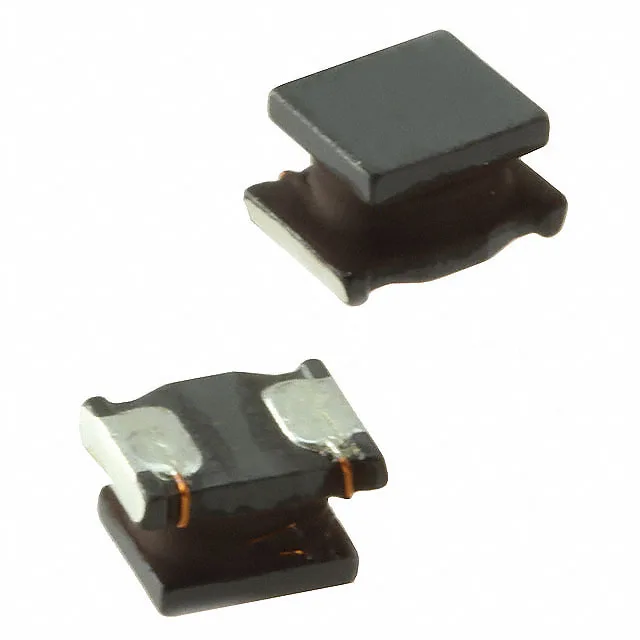
DC bias and saturation headroom for power rail filtering
The LQH43PB4R7M26L is a 4.7 µH shielded wirewound inductor from Murata's LQH43 series, rated for 780 mA continuous current with a 90 mOhm max DCR. That DCR at 780 mA produces about 55 mW of I²R loss — well within the 1812 package's dissipation capability at 85°C ambient, but worth checking if the inductor sits next to a hot regulator. The 1.4 A saturation current (Isat) is the point where inductance typically drops by 30%. With a 780 mA rated current, you have roughly 80% headroom to Isat — enough to handle the inductor current ripple plus a 20% load transient without the inductance collapsing into the noise floor of a buck converter's current loop.
Shielding and frequency limits in a dense layout
The ferrite core and shield contain the magnetic flux — important when this inductor shares a board with a 2.4 GHz radio front-end or a precision ADC. Without the shield, the fringing field from an unshielded drum core would couple into nearby traces and shift the converter's switching noise spectrum into the signal band. Self-resonant frequency is 35 MHz. Below that the part behaves as an inductor; above it the winding capacitance dominates and the impedance rolls off. For a 500 kHz to 2 MHz switching regulator, this SRF is comfortably above the switching harmonics — but if you are using it as a DC bias choke for a 10 MHz signal path, check that the fundamental and first few harmonics stay under 35 MHz.
Temperature grade and board-fit dimensions
A DC-DC converter in an engine bay ECU that sees 105°C on the PCB still has 20°C of margin before the inductor's rated ceiling. The ferrite core material's permeability will drift with temperature, but the inductance tolerance of ±20% already accounts for that shift across the band.