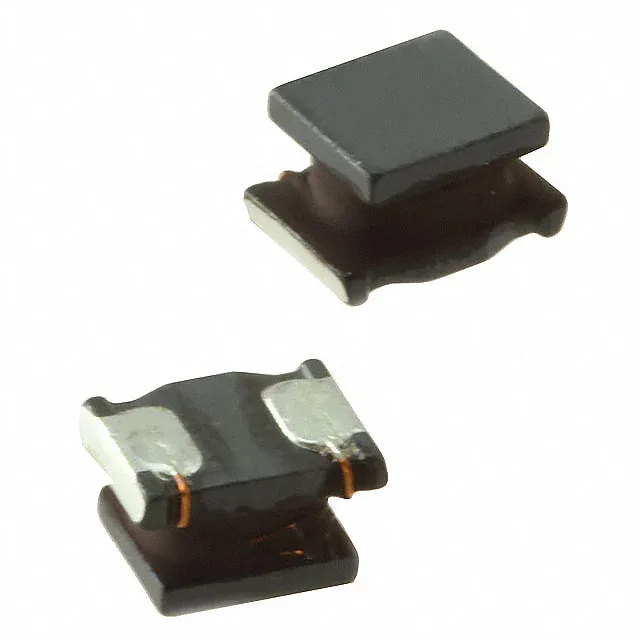
47 µH wirewound — what the ratings mean for your BOM
The Murata LQH43NN470J03L is a drum-core wirewound inductor in the LQH43 series, delivering 47 µH inductance with a ±5% tolerance. This is the value that sets the LC filter corner or energy storage in a DC-DC converter — if your circuit calls for 47 µH, this part lands within 2.35 µH of that target. Rated for 220 mA continuous current, the inductor's 1.5 Ohm max DCR means at full load the copper loss is about 73 mW (I²R). Unshielded construction means the magnetic field from the drum core can couple into nearby traces or components. On a dense board, keep a clearance of at least one part width (4.5 mm) from sensitive analog or RF circuits to avoid unwanted coupling.
Frequency response — Q and self-resonance
A Q factor of 35 at 1 MHz tells you the inductor's reactance-to-resistance ratio at that frequency — higher Q means lower energy loss per cycle. For a 1 MHz switching regulator, this Q is adequate for filtering; for a narrowband RF tank circuit, you'd typically look for Q above 50. The self-resonant frequency of 10 MHz is the point where the inductor's parasitic capacitance cancels its inductance — above 10 MHz the part behaves capacitively. Keep your operating frequency at least a decade below 10 MHz (1 MHz or lower) to stay in the inductive region. Inductance is tested at 1 MHz, which matches the Q test frequency — this is the manufacturer's reference point for verifying the 47 µH value.
Board-fit and sourcing posture
The ferrite core and wirewound construction are the same as other LQH43 parts, so if you've used the series before, the pad layout and reflow profile transfer directly. Sourced through independent distribution channels.