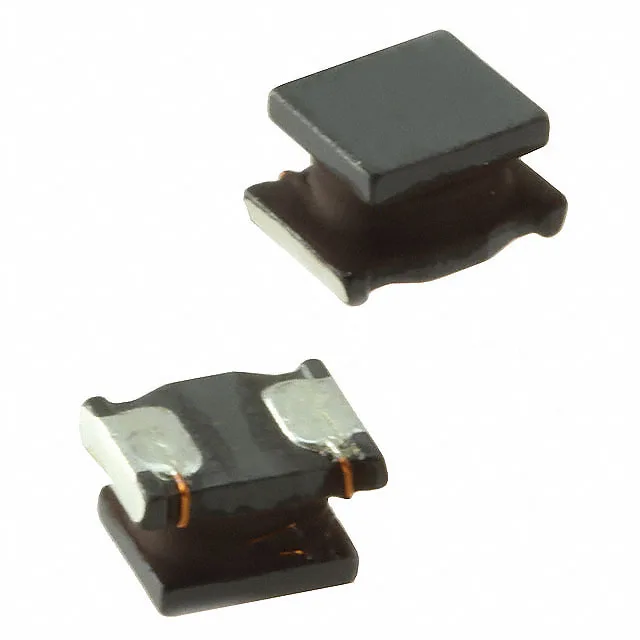
56 µH, 180 mA — what the ratings mean for your circuit
The LQH43NH560J03L: 56 µH inductance at 1 MHz test frequency, ±5% tolerance — the tight tolerance keeps the resonant frequency of an LC filter or the ripple current in a buck converter within a narrow band, which matters when the inductor is the frequency-setting element. 180 mA continuous current rating with a 1.608 Ω max DCR — at full rated current the copper loss is about 52 mW, negligible for most boards, but in a high-density layout the self-heating adds to the ambient temperature and must stay within the 125°C operating limit. Self-resonant frequency of 9.3 MHz — above this frequency the impedance becomes capacitive, so the part is useful as an inductor only below roughly 2–3 MHz in practice, depending on the circuit's impedance tolerance.
AEC-Q200 and the 125°C ceiling
AEC-Q200 qualification means the inductor has passed automotive-grade stress tests: thermal shock, moisture resistance, mechanical shock, and vibration per the AEC-Q200 passive-component standard.
Unshielded drum core — layout awareness
Unshielded construction means the magnetic field radiates from the drum core — in a dense PCB layout the stray field can couple into nearby signal traces or other inductors, so spacing and orientation matter more than with a shielded part.