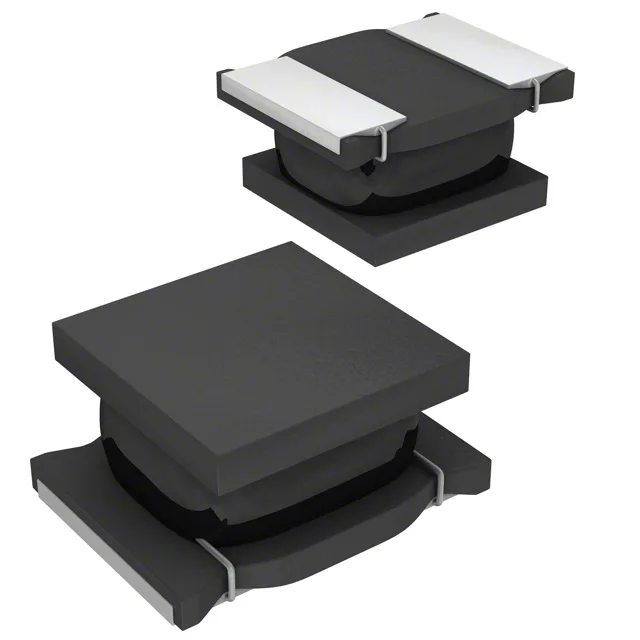
2.2 µH shielded wirewound, AEC-Q200 qualified
The Murata LQH3NPZ2R2MGRL is a shielded drum-core wirewound inductor in the LQH3 series, rated 2.2 µH ±20% at 1 MHz. It carries a continuous current rating of 1.03 A and a saturation current of 1.18 A, with a maximum DCR of 104.4 mOhm. AEC-Q200 qualification means this part is characterized for automotive-grade stress — temperature cycling, moisture resistance, and mechanical shock per the automotive passive-component standard.
Current handling and DC resistance trade-off
With a 1.03 A continuous rating and 1.18 A saturation floor, the inductor stays in its linear inductance region up to the saturation limit — the 14% headroom above rated current means the inductance does not collapse abruptly under transient loads. The 104.4 mOhm DCR at 2.2 µH is typical for a 3.0 mm × 3.0 mm footprint; the I²R loss at rated current is about 110 mW, manageable without forced airflow. Self-resonant frequency of 50 MHz places the usable bandwidth well above the switching frequencies of common DC-DC converters (typically 500 kHz to 2 MHz), so the inductor behaves as a pure inductance in the power train without parasitic capacitance effects.