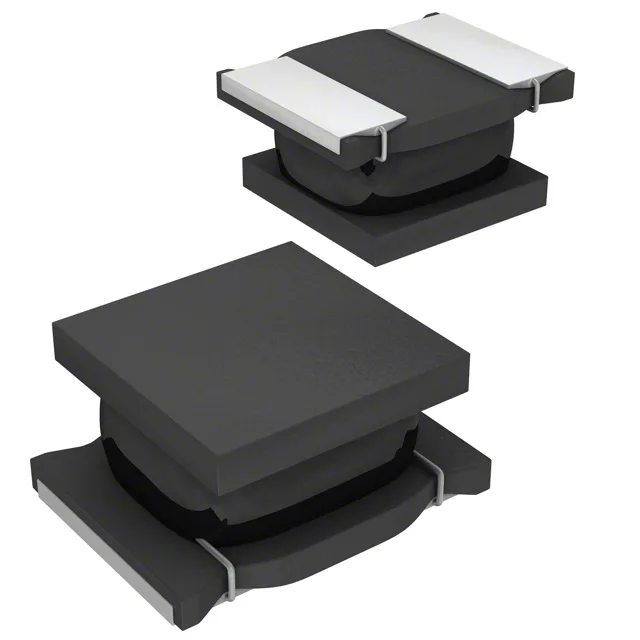
What the 1.6 A rating means for your rail
The LQH32PN2R2NN0L is a Murata shielded wirewound inductor rated for 1.6 A continuous and saturates at 1.55 A. That 1.6 A is the DC current before the inductance drops 10% from the 2.2 µH value — the real usable current in a buck converter ripple is lower because the AC component pushes the peak above the DC average. For a 12 V to 3.3 V rail at 1.2 A load, the peak inductor current hits around 1.4 A, leaving headroom before saturation. The 91.2 mOhm DCR produces about 233 mW of I²R loss at 1.6 A — that heat has to go into the 1210 footprint without much copper area. On a 2-layer board with 1 oz copper, the temperature rise above ambient will be around 25-30°C at full rated current, so the 85°C ambient limit means the inductor surface stays under 115°C.
Shielded construction and SRF margin
The ferrite core and magnetic shield keep the flux contained — no coupling into adjacent traces or a nearby GND plane. For a 2.2 µH part in a 500 kHz to 2 MHz switching regulator, the 70 MHz self-resonant frequency is well above the switching harmonics, so the inductor behaves like an ideal inductor across the regulator's bandwidth. The ±30% tolerance means the actual inductance at 1 MHz test frequency can range from 1.54 µH to 2.86 µH. In a regulator with a fixed compensation network, that tolerance shifts the crossover frequency — design the loop with the worst-case low inductance to avoid instability at light load.
Board-fit and rework considerations
The nonstandard package means the pad layout matches the Murata drawing, not the generic 1210 chip footprint; the end terminations are on the short sides, so orientation matters during hand placement. Rework with a standard hot-air station at 300°C for 10 seconds per side is fine — the ferrite core doesn't crack like a ceramic cap. No moisture sensitivity level (MSL) baking needed for this type of wound inductor; it comes out of the cut tape and goes straight onto the paste.