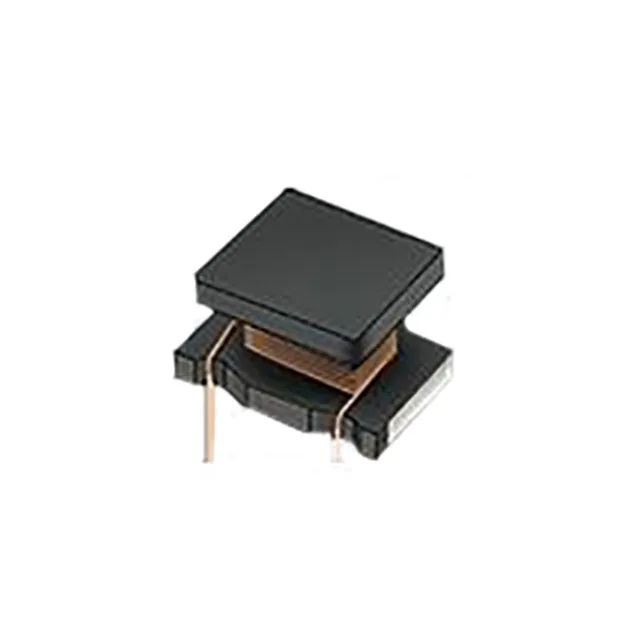
470 µH wirewound for low-current filtering and bias-T circuits
The Murata LQH32MN471K23L is a 470 µH unshielded drum core wirewound inductor from the LQH32 series, housed in a 1210 (3225 Metric) surface-mount package. Its primary role is to provide inductance in DC-DC converter output filters, bias-T networks, and low-current EMI suppression where the 45 mA current ceiling is not exceeded.
DC bias and loss budget — what the ratings mean for the BOM line
Rated at 45 mA DC, this inductor saturates or overheats if the average current plus ripple exceeds that limit — a 40 mA load with 10 mA ripple already pushes the margin. The 25 Ohm maximum DCR drops 1.125 V at full rated current (45 mA × 25 Ω), which may be acceptable in a 5 V rail but consumes over 50 mW in I²R loss alone. The self-resonant frequency of 5 MHz sets the upper bound for usable inductance — above this frequency the impedance turns capacitive, so the part is best suited for switching frequencies below 1–2 MHz where the inductive reactance dominates. The Q factor of 50 at 796 kHz indicates moderate efficiency at that test point, typical for a ferrite-core wirewound of this value. Inductance is tested at 1 kHz, which is a standard low-frequency reference — the actual inductance at the operating frequency will be slightly lower due to core permeability roll-off, but the 470 µH nominal value holds well below the SRF.
Board-fit and temperature envelope
The unshielded construction means magnetic flux couples into nearby traces — keep sensitive signal routing at least one component width away to avoid crosstalk. The inductance tolerance of ±10 % is tight enough for most filtering and resonant applications, though a tighter grade may be needed for precision tuned circuits.