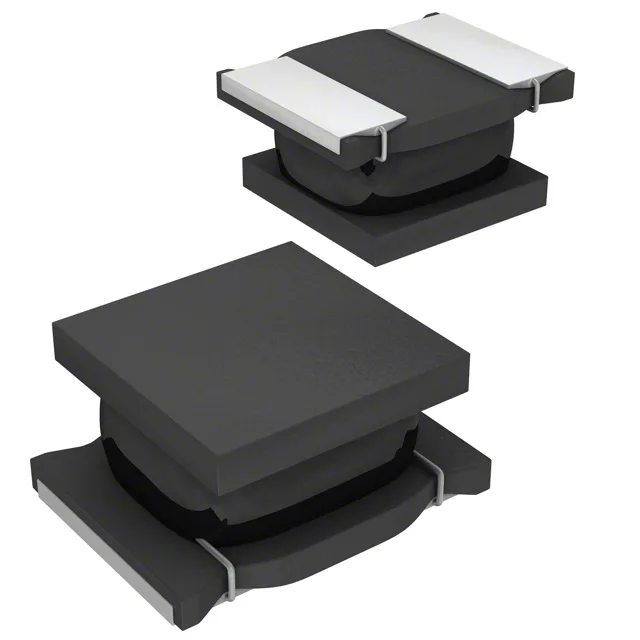
3.3 µH, 710 mA — what the ratings mean for the BOM
The LQH32DN3R3M53L is a Murata drum-core wirewound inductor in the LQH32 series, rated 3.3 µH at 1 MHz test frequency with ±20% tolerance. The 710 mA current rating is the same as the saturation current — meaning the inductance holds to within the tolerance band up to that DC bias level, then rolls off. For a rail carrying 600 mA continuous, this part has margin; at 700 mA the inductance starts to sag. DC resistance is 156 mOhm max, which at 710 mA dissipates about 79 mW of copper loss — well within the part's thermal budget at 105°C ambient. The unshielded construction means the magnetic field extends beyond the package; keep sensitive traces or other magnetics at least one part width away to avoid coupling. Self-resonant frequency is 50 MHz — above that the component behaves capacitively. For a buck converter switching at 2 MHz, this inductor is well below SRF and behaves as a pure inductive element.
1210 footprint and rework reality
The nonstandard case designation means the pad layout follows the 1210 industry standard — the part lands on the same footprint as any generic 1210 chip inductor. Surface-mount, tape-and-reel packaging for pick-and-place; cut-tape available for prototypes. Rework is straightforward — the ferrite core and wirewound construction handle standard lead-free reflow profiles without cracking. The part has no polarity marking, so orientation is irrelevant for placement. A hot-air station at 300°C with a 3-second dwell lifts it clean; the pad geometry is forgiving for manual touch-up.