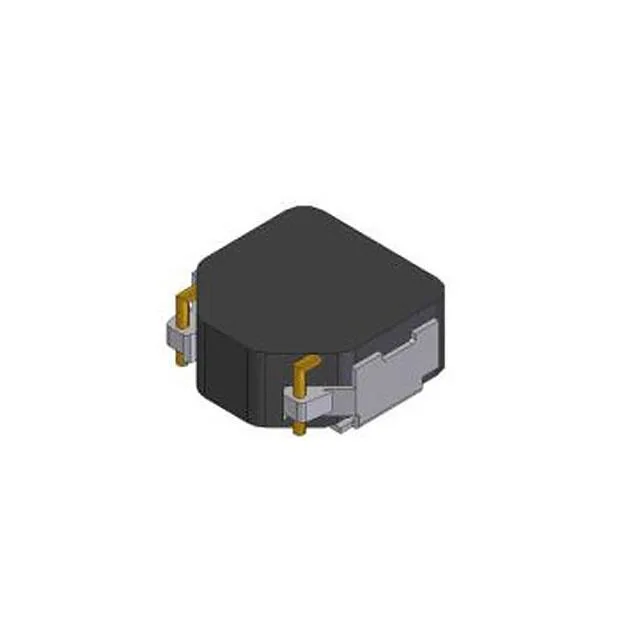
The DFEH7030D-8R2M=P3: This is the official lifecycle status — the part remains available for existing production but is not intended for new BOM entries. The last-time-buy window is open; once it closes, the only supply channel will be independent surplus.
Current and saturation — the real load limits
Rated 3.1 A continuous current with a saturation current (Isat) of 4.2 A. The saturation rating is the point where inductance typically drops 30% — for a buck converter drawing 3 A steady-state, a 4.2 A Isat gives roughly 40% headroom for load transients before the inductor saturates and the current ramp becomes uncontrolled. DC resistance is 78 mOhm max, which at 3.1 A produces I²R conduction losses of about 0.75 W. In a compact 7.00 mm x 6.60 mm surface-mount package with a 3.00 mm seated height, that heat must be conducted through the PCB copper — the board layout's thermal via pattern under the inductor directly sets the steady-state temperature rise.
Automotive-grade screening and temperature range
AEC-Q200 qualified — this inductor passed the automotive passive-component stress tests: thermal shock, moisture resistance, mechanical shock, vibration, and solderability. The -40°C to +155°C operating range covers under-hood and engine-bay environments where ambient temperatures exceed 125°C. The iron powder core material gives stable inductance under DC bias compared to ferrite, which saturates more abruptly. For a 12 V automotive rail feeding a 3.3 V point-of-load converter, the inductor sees a DC bias near the load current — iron powder holds its inductance better than ferrite at that bias point.
Shielding and EMI — why it matters for power rails
Shielded construction — the magnetic flux is contained within the core and shield, reducing radiated emissions that couple into adjacent traces or the input-sense line of a nearby regulator. In a dense automotive ECU layout where a buck inductor sits 2 mm from a CAN transceiver, the shielding is what keeps the EMI below CISPR 25 Class 5 limits.