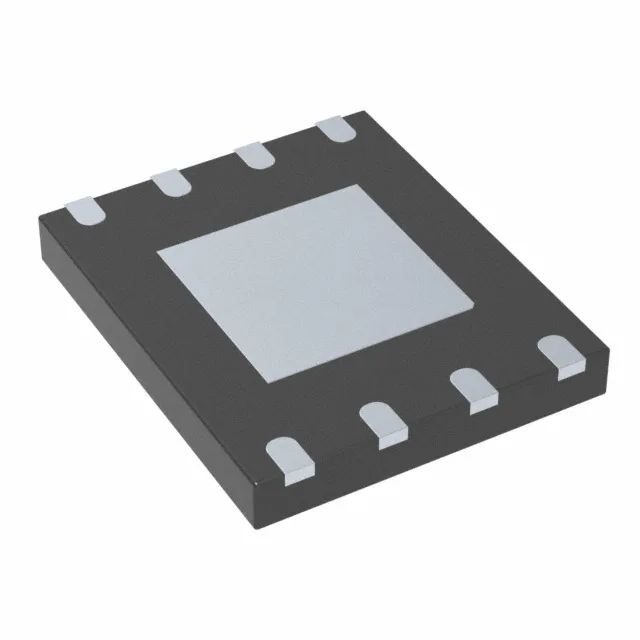
Package and board-fit — 8-WDFN exposed pad
The MT25QL128ABA1EW7-0SIT TR: The 0.65 mm typical lead pitch is fine for a two-layer board if the ground pad is stitched with enough vias. If the part has been exposed to ambient humidity beyond the floor life, bake it at 125 °C for 48 hours before reflow to avoid popcorning.
128 Mbit density and the read-throughput ceiling
Organised as 16M x 8 bits, this 128 Mbit NOR flash provides the code-storage or data-logging capacity for a firmware image that fits within that footprint — typical for a bootloader plus application image in a Cortex-M class processor. The SPI Quad I/O interface at 133 MHz delivers a theoretical read throughput of 532 Mbit/s (quad data rate), which is enough for execute-in-place (XIP) from flash without a separate RAM shadow for most real-time control loops. The page program time of 2.8 ms and sector erase time of 8 ms define the write-performance budget for over-the-air firmware updates. A full 64 KB sector erase at 8 ms means updating a 128 Mbit device sector-by-sector takes roughly 2 seconds of erase time alone — budget this into the update window and consider a dual-bank scheme if the system must stay responsive during the write.
Supply voltage and temperature grade
No separate VDDQ or VPP is required, which simplifies the power tree and saves a regulator on the BOM. The 85 °C ceiling is the typical limit for commercial-industrial gear; if the junction temperature exceeds this in a high-ambient application, the read current and write endurance derate per the Micron datasheet curves.
The Tape & Reel packaging (Cut Tape also available) suits automated pick-and-place assembly in medium-to-high volume runs.