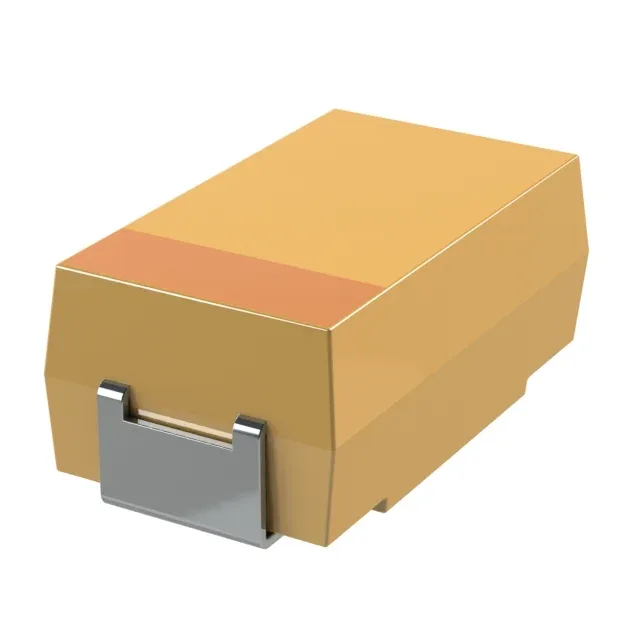
The TPSD476K016R0100: Its 47 µF capacitance at a 16 V rating puts it squarely in the range for bulk decoupling on a 12 V supply rail — the 16 V rating provides about 33 % headroom above a nominal 12 V, which is comfortable for a well-regulated rail but not enough for a 12 V bus that sees transients above 16 V. The 100 mΩ ESR is the parameter that drives the real-world performance. At 47 µF and 100 mΩ, the self-resonant frequency sits around 230 kHz — below that the cap looks capacitive; above it the ESR dominates the impedance. For switching regulators switching in the 200–600 kHz range, this ESR is high enough that a single cap won't knock down the ripple the way a low-ESR polymer would, but it is typical for a tantalum of this size and keeps the ripple current rating around 1.2 A at 85 °C.
No end-of-life notice, no last-time-buy clock ticking.
D case footprint and the seated height gotcha
The seated height is 3.10 mm max. That 3.10 mm is the clearance number to watch: it fits under most low-profile components on a standard 1.6 mm PCB, but if you are stacking boards with a 3.0 mm gap, this cap will short. The molded construction gives a flat top, which helps with pick-and-place vacuum pickup. Operating temperature spans -55°C to 125°C — full industrial and military range. No derating needed for most environments, but tantalum caps do have a voltage derating guideline: running at 50 % of rated voltage (8 V on this 16 V part) improves reliability significantly. At 125 °C, the recommended derating is typically 2/3 of rated voltage.