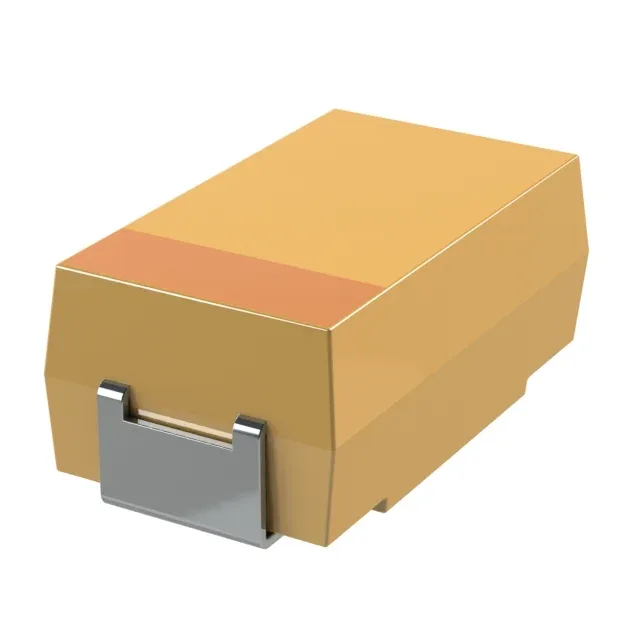
Bulk capacitance for power rail decoupling
The TPSD337K010R0065 delivers 330 µF at 10 V rated in a molded D-case (2917 metric) package — a standard footprint for tantalum capacitors used in point-of-load decoupling and hold-up energy storage on 3.3 V, 5 V, and 1.8 V rails. With 65 mOhm ESR, this part handles ripple currents that would overheat a higher-ESR tantalum at the same capacitance — the ESR figure directly governs the self-heating under AC ripple and the voltage droop during transient load steps. The -55°C to 125°C operating range covers the full industrial temperature envelope and extends into automotive under-hood zones where the ambient near the ECU can reach 105°C with margin.
Molded construction and ESR trade-offs
Molded tantalum capacitors use a conformal epoxy encapsulation over the sintered anode and cathode — this construction provides better mechanical protection than dipped types and tighter dimensional control for pick-and-place assembly. The 65 mOhm ESR is the key selection parameter for power rail decoupling: a lower ESR means less voltage ripple at the load for a given ripple current, but also reduces the damping of LC resonance with the PCB inductance — a trade-off the board designer must evaluate against the target impedance profile. The ±10% tolerance is typical for tantalum capacitors in this class — the actual capacitance at the rated voltage and temperature will shift within this band, so the design should budget for the -10% corner when sizing hold-up time or filter cutoff frequency.
Active production — sourcing reality
No stock-holding claim is made; each order is quoted individually.