The ±20 % tolerance means the actual capacitance can range from 54.4 µF to 81.6 µF; a filter corner frequency or timing circuit that depends on the exact value needs a tighter tolerance part, but for decoupling the ±20 % band is standard and the ESR dominates the ripple performance anyway.
500 mOhm ESR — the ripple and self-heating limit
For a switching regulator output, a lower-ESR tantalum (e.g., 100 mOhm in the same TPS family) would cut that ripple by a factor of five, but the 500 mOhm part is still adequate for many general-purpose decoupling and hold-up roles. ESR also governs self-heating: the I²R loss inside the capacitor raises the internal temperature above ambient. At 1 A ripple, the dissipation is 0.5 W — the molded 1411 case (3.50 mm x 2.80 mm footprint) can shed that heat if the board has a copper pour under the part, but in a dense layout the temperature rise may push the internal temperature closer to the 125 °C ceiling.
The molded construction and the tantalum anode chemistry maintain capacitance stability across that band, though the ESR rises at low temperature — expect roughly double the 25 °C ESR at -55 °C.
1411 (3528 Metric) case — rework and footprint notes
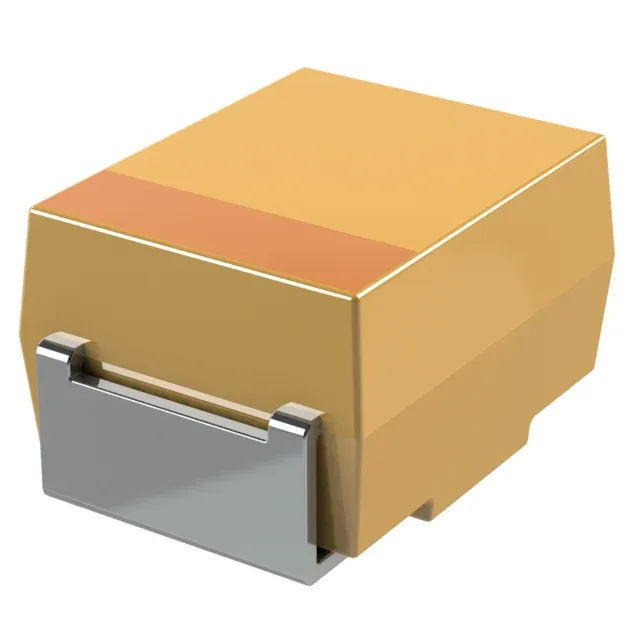
The package is the standard 1411 (3528 Metric) tantalum case, size code B, measuring 3.50 mm x 2.80 mm with a seated height of 2.10 mm max. The molded body has clear polarity marking — the band on the positive end — so orientation is unambiguous under a microscope. Reflow soldering is the intended attachment; the part survives standard lead-free profiles (MSL 1 typically, though the datasheet should confirm). Hand rework with hot air is feasible: the case is small enough that the body heats quickly, and the end caps are accessible for a tweezer lift.