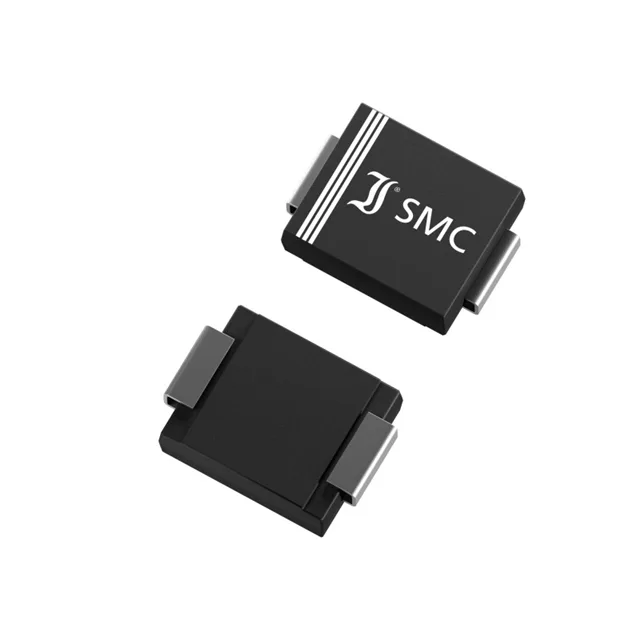
Clamping performance and standoff rating
The 1.5SMCJ85: The 85V reverse standoff is the working rail the diode sits across idle — it does not conduct until the transient pushes the line above this level. When it does clamp, the 151V maximum clamping voltage at 9.9A peak pulse (10/1000 µs waveform) tells the layout engineer what the downstream circuit sees at the moment of suppression — the clamping voltage multiplied by the peak current gives the instantaneous let-through energy the protected node absorbs. The 1.5 kW peak pulse rating is a single-event, non-repetitive figure — a 1.2/50 µs or 8/20 µs surge that stays within this energy ceiling does not degrade the junction. Sustained or repetitive transients above this level shift the clamping characteristic and are the reason a TVS chosen at the rail margin — not the absolute maximum — lasts the product lifetime.
Junction temperature and the thermal margin
At the high end the clamping voltage rises with temperature — a TVS that holds 85V standoff at 25°C may sit closer to the rail at 125°C ambient, so the layout thermal resistance from junction to ambient must stay within the datasheet curve to keep headroom. The DO-214AB SMC package gives the cathode tab a thermal pad the size of the full package width — the board pad area under that tab is the primary heatsinking path. With the tab soldered to a generous copper pour, the RthJC stays low enough that the 1.5 kW single-event rating is achievable without an external heatsink.