What the voltage stack means for downstream protection
The 1.5SMCJ7.5: That clamping ceiling is the number that sizes your downstream protection margin: the downstream bus gets held to 14.3 V even when the transient source is capable of much higher. The peak pulse rating of 105 A at the standard 10/1000 µs waveform tells you the diode survives a single 1.5 kW surge event without degradation. This waveform — 10 µs rise, 1000 µs fall — approximates the IEC 61000-4-5 ring-wave and some lightning-surge profiles, so the part is suitable for input-stage protection on equipment that must survive mains-adjacent transients. The SMC/DO-214AB package gives enough die-area to dissipate that pulse energy without exceeding the 150 deg C junction limit.
Where it goes on the board
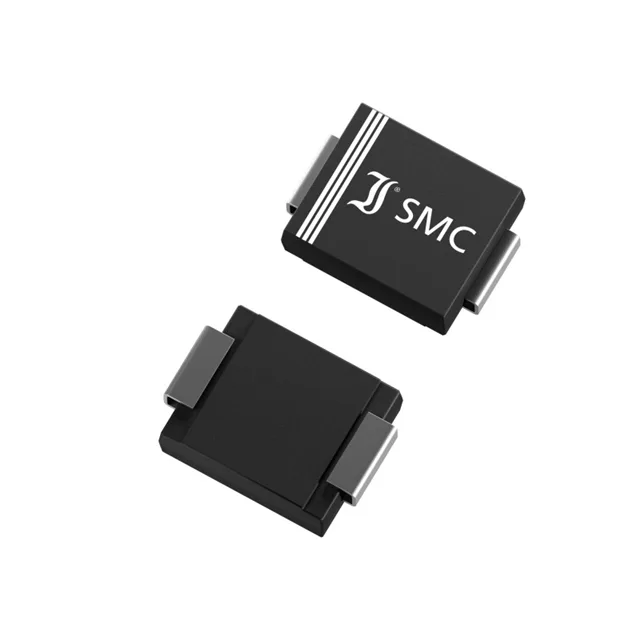
Surface-mount SMC/DO-214AB is the standard package for 1.5 kW unidirectional TVS diodes — the foot print is widely supported and the tab area handles the thermal demand of a single surge event. The -50 to 150 deg C junction temperature range gives headroom for industrial environments where the board ambient can spike — the derating curve in the datasheet tells you how much DC bias current you can run at elevated board temperature before the junction limit becomes the constraint. General-purpose marking means no application-specific qualification — it is the default production grade TVS Zener, not AEC-Q automotive or medical-grade. It covers the majority of PCB input protection roles: power supply rails, signal lines, and secondary protection behind a primary bulk-clamp device. For automotive or industrial safety circuits, confirm the relevant IEC 61000-4-5 test level is met by the specific test setup — the datasheet waveform rating is the reference point.