TVS ratings — what the voltage window means for your circuit
The 1.5SMCJ78A-AQ: The reverse standoff of 78 V defines the working voltage the protected line sits at during normal operation — the diode stays off and draws only leakage current until a transient pushes the anode above that threshold. This 126 V clamping ceiling is the number that determines whether downstream bus transceivers, motor drivers, or sensing circuitry survive the automotive load-dump or inductive kick profile the board is designed against. Rated 1.5 kW peak pulse means the part handles the energy content of a defined IEC 61000-4-5 surge — 1.5 kW at the standard 8/20 µs or 10/1000 µs wave shape depending on which test condition is specified in the Diotec datasheet. For a 78 V rail in an automotive 12 V system, this rating covers Class III and Class IV transient environments without needing a paralleling arrangement. Unidirectional only — this device protects against transients of one polarity, with the cathode biased positive relative to the anode. For AC signal lines, motor winding leads, or any node that sees bipolar stress, a bidirectional TVS or a back-to-back pair is required. Power line protection is not listed as an application, confirming the primary target is signal and control line clamping in the 78 V rail band.
Automotive thermal environment and junction rating
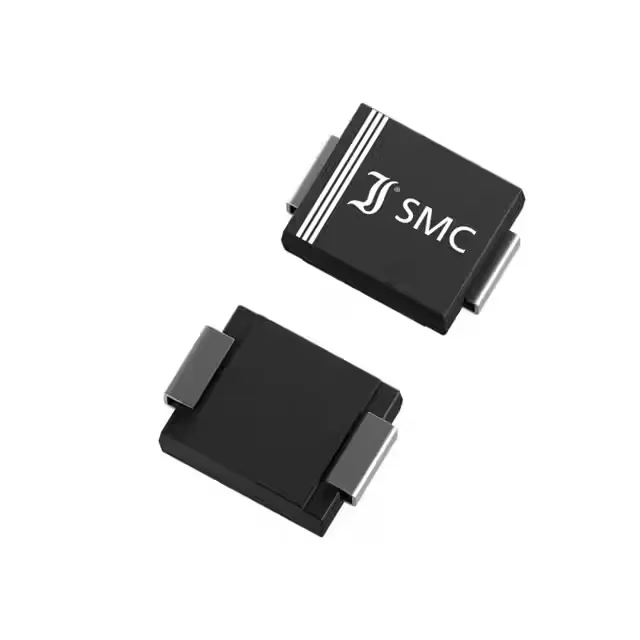
The part is listed under Automotive applications, placing it in the qualification and traceability class required by AEC-Q101-grade suppliers. The DO-214AB (SMC) package is the mid-power surface-mount TVS outline — larger than the SMA (DO-214AC) but with better thermal performance for the 1.5 kW rating. Footprint is compatible across the 1.5SMCJ family, so a board designed for this part accepts other voltage variants in the same package without a layout spin. The strip packaging designation means it ships in tube or reel depending on the order quantity — confirm the delivery format with the supplier before committing a pick-and-place program.
Diotec Semiconductor lists this part as Active. For a mainstream automotive TVS in a standard SMC footprint, this means the design-in window is open and second-source candidates from other AEC-Q101-qualified suppliers exist in the market — a BOM-level hedge can be evaluated at RFQ without waiting for a PCN to surface.